Graduation of Ines Ben M’hamed: The Strength of Clay in a Test Rig

Ines Ben M’hamed defending her graduation thesis

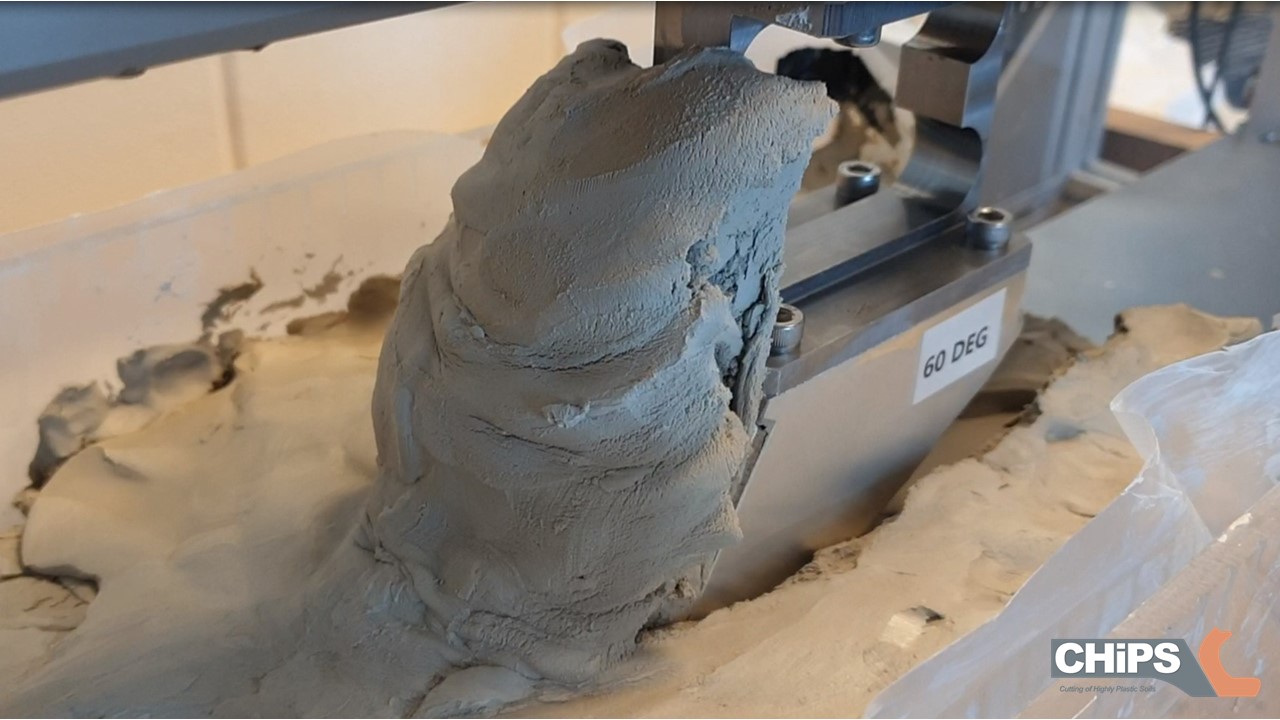
Last week, Ines Ben M’hamed graduated with good grades on her bachelor thesis. She did a project with us at the Research Department of Damen Dredging Equipment in Nijkerk. The topic was to investigate the strengthening of clay when it is subjected to shear. This deformation is a common phenomenon when cutting clay and as such a contribution to my own PhD project1 and consequently improving our products for these applications. A common problem with clay is clogging up the cutter head, but it is also not completely understood why the clay is behaving as it does and how much power is involved for the various regimes.

Fully covered cutter head in sticky clay

The effects of deformation on the behaviour of clay are much more pronounced than e.g. sand or rock. Rock does not deform, it just breaks. Sand deforms, but as it basically only involves hydraulic and mechanical forces, it is much better understood. Clay particles have wider range of interactions. Next to the hydraulic and mechanical forces, they may experience: adhesion and cohesion, molecular forces, electrostatic charges and chemical bonding in the higher temperature ranges. The general effect is that as the particles in the original situation may have a weak structure, the external disturbance causes the particles to get jostled around and all the mentioned interaction get a chance to hook on to each other.

Shear strengthening due to organising particles

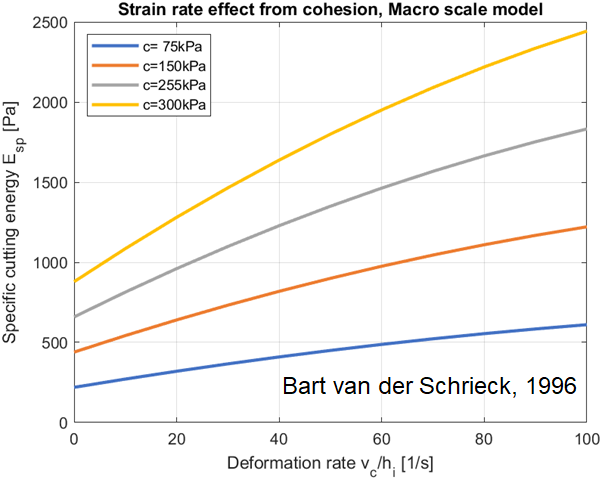
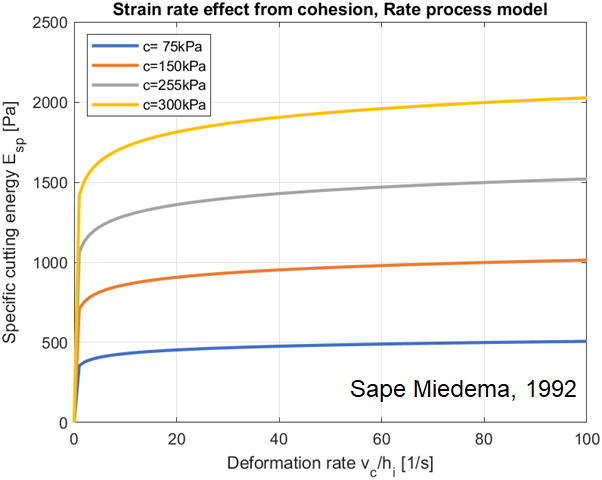
The result is, that the particles get oriented and therewith a better opportunity to bond. The effect is a strengthening of the shear stress. As this strengthening is dependent on the strain rate, it is this strain rate, that is of interest for the prediction of the cutting forces. There are many publications available on what the consequences are of the strain rate on the Specific Cutting Energy. A well known model is by Sape Miedema2.

Strain Rate Effect on the Specific Cutting Energy (Credit: SA Miedema)

The trick with this model is, it depends on this strain rate effect. The sole experimental data available is by Hatamura and Chijiwa3 in 1975. They tested one type of clay on the three governing parameters: static shear strength, dynamic shear strength and the strain rate. There hasn’t been hardly any further experimental investigation into this problem. And as we regularly receive samples and soil reports that we can not test on these properties, it is also hard to predict the performance of our cutter heads. So, we decided to build our own cutting test rig.

Design of Ines’ cutting test rig

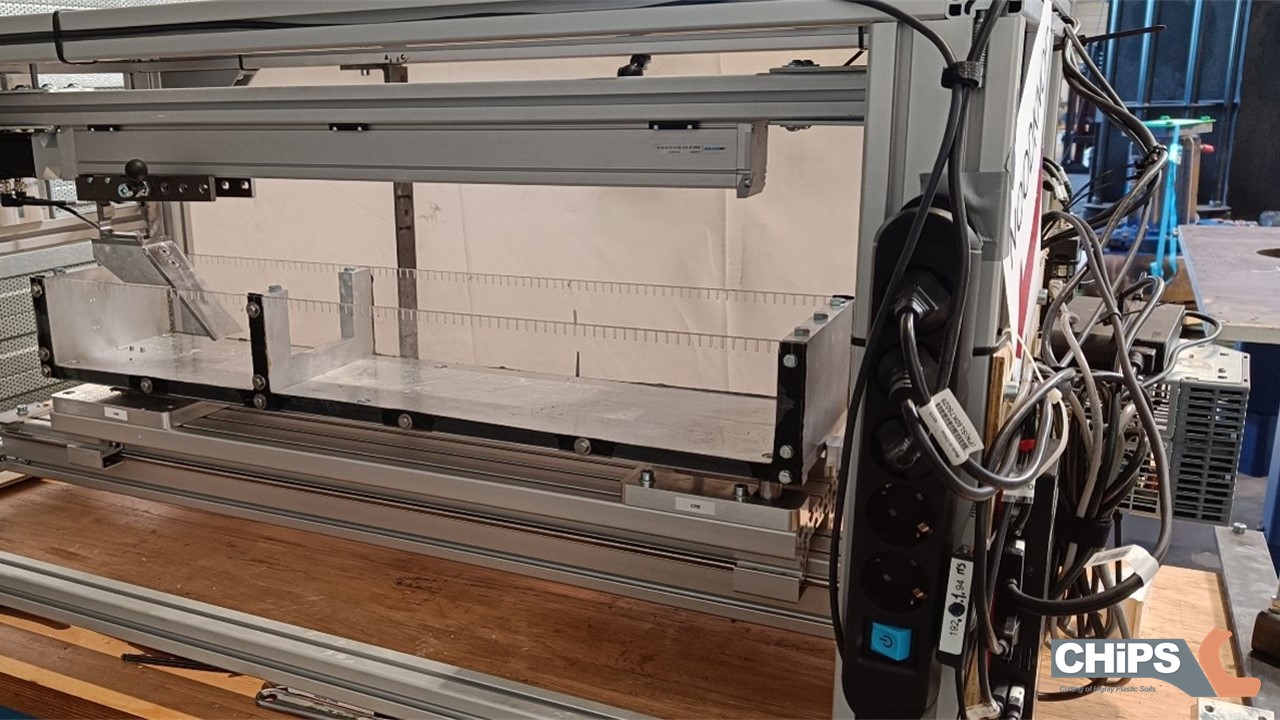
This cutting test rig resembles the specifications to the original test rig of Hatamura. This will allow us to verify the parameters in the model ourselves. We also prepared the design with various option to enable us to allow assessment of clay samples that we receive from clients and service engineers. We hope to provide our customers with additional service in this problem. Currently, the parts of the test rig arrived very late and Ines was not able to include the build in her project. Respect for the good grade she received for her thesis. However, the parts are there and provide and excellent opportunity for the next graduation student to do their project with our company. Who dares?

Available parts for the cutting test rig

References

  1. Personal Announcement: Going Back To School To Cut Some Clay, Discover Dredging
  2. The Delft Sand Clay & Rock Cutting Model, SA Miedema
  3. Analysis Of the Mechanism of Soil : 1st Report. Cutting Patterns of Soils, Hatamura & Chijiwa

See also


Personal Announcement: Going Back To School To Cut Some Clay

Learning early or later in life, studying is always a joy when you make it practical

‘Never too old to learn’ is my motto. Everyday I look around me and I wonder how this beautiful world fits together. Whether it be the stars in the sky, the waves at sea or life as we know it, there is always something to be learned about it. At school, I was not a great pupil, but I was always curious to learn more. For my master thesis at the Delft University of Technology, I investigated the performance of a dredge and made recommendations to improve its operation1. As the project was more focussed on mixture forming (and turbidity) and the redesign of the auger head, there was no attention for the soil mechanics involved in the cutting process.

Fully covered cutter head in sticky clay

Now is the time to get that straight. In my daily business, I came across several projects where the clay cutting was a real problem. This was one of the triggers that sparked my interest in sticky clay and made me pursue a more detailed investigation into this nasty stuff. I am very grateful my management was willing to grant me time to go back to the university and start a PhD project with professor Cees van Rhee to learn more about clay.

Synthesis of clay and the relevant properties for dredging

Clay is a completely different material than sand or rock. Those are either plastic and non-cohesive or elastic and cohesive. Clay is the worst of both worlds: plastic and cohesive. It can be described with certain soil parameters as e.g. undrained shear strength and internal friction angle. The failure model is based on Mohr’s circle etc. But those are all continuum approaches2. When you zoom in to the particle level of clay, a whole new world opens up. I already wrote about the interesting particle interaction in a previous post3.

Boltzmann strain rate function in clay cutting

It appears, that the consistency, deformation and failure of clay is related to the tiny electric charges distributed over the platelet crystals. The movement along the charges needs energy. The model to describe dislocation energies along electric charges has been studied by Ludwig Boltzmann4,5. His model governs a wide range of applications, ranging from cosmology to particle physics. I really plunged into the deep end of science with just simple clay. It already took some time to get my head around the concepts involved. Slowly it dawns on my what possibilities there are to improve our understanding of the cutting of clay and possibly to improve our products eventually.

Gallery of my dredging professors (l) prof. de Koning, (m) prof. Vlasblom, (r) prof. van Rhee

My ‘old professor’ de Koning was a proponent of ‘thinking with your hands’6. Professor Vlasbom encouraged me to graduate on a practical problem and also my current professor van Rhee suggested to do some preliminary experiments with sticky stuff to get some feeling about what I am going to study. Of course I took some clay home to play with it. But the best suggestion was by my colleagues, who thoughtfully gave me stroopwafels7. The ultimate representation of sticky non-Newtonian stuff between layers of latticed disks.

Fresh supply of stroopwafels for practice and celebration

References

  1. Presenting Pump Power Peculiarities, Playing With Pumps And Pipes, Discover Dredging
  2. The Cutting of Sand, Clay and Rock – Soil Mechanics (6041), TU Delft
  3. The Origin of Clay, When Dredging Becomes Sticky, Discover Dredging
  4. New Developments Of Cutting Theories With Respect To Dredging The Cutting Of Clay, SA Miedema
  5. Ludwig Boltzmann, Wikipedia
  6. Experience the Dredging Experience
  7. Stroopwafel, Wikipedia

See also

Graduation Omar Karam: Rock Cutting The Egyptian Way

Graduation presentation of Omar Karam

Egypt is a great nation when it comes to ancient engineering. No other country has such a concentration of impressive monuments and such an interesting history as over there. If you are not convinced that modern Egyptians are not capable of great engineering feats you are wrong. Last Monday, Omar Karam graduated at our R&D department of Damen Dredging Equipment1 on his thesis about ‘CSD Rock Cutting.’

Cutting processes have been extensively described by Sape Miedema in ‘The Delft Sand, Clay & Rock Cutting Model’2. Omar has been using the frame work of Miedema to make some useful tools for the estimation of the production of our dredging equipment in rock. In due time, you will find the results of his thesis in the online dredge selection tool ‘Sandy’. Omar’s curiosity and ingenuity does not end here. He will continue studying at a university, but I do hope to meet him again, as he would be a valuable asset for our dredging community. Keep an eye out for him.

Program structure diagram of cutting force calculations

His graduation brings me back to my first lessons in dredging technology at the Delft University of Technology by the illustrious professor de Koning. In a sense he was an old school engineer, who hammered it in to us that thinking is done by doing it with your hands3. Back than the Polytechnic School was just rebranded to University and he was mocking that as a university, we had to set the topics in a broader perspective. So, he started his introduction on cutting technology with some slides of the unfinished obelisk at Aswan4 as every aspect of the cutting process could be illustrated.

Phases of chip forming in rock cutting

The story according to de Koning is: ‘Around the quarry of the obelisk, they have found diorites5. These are some sort of volcanic balls of rock. In combination with the marks and scratches all around the obelisk, archaeologists believe these stones have been used to pound the granite. The impact compresses the bedrock and the resulting stresses fracture the contact surface(1). For every hit a whiff of dust is created. Eventually the dust is collected and scooped away for the next layer. Next, trees would be planted in the trench on one side of the obelisk. The growing root system displaces volume and create shear stress underneath the obelisk that would sever the obelisk from the bed rock(2). At last the trees are removed and dry wooden dowels would have been inserted in the shear cracks. Saturating the wooden dowels will make them grow. The last strands of rock will now be broken due to tensile stresses(3). Repeated insertion of new dry dowels and saturating them will lift the whole obelisk enough to pull some ropes under and carry the obelisk away to the building site.’

Although the diorites and the scratch marks are a smoking gun, current archaeologists argue about the feasibility of this process as experiments yield a very low production and it is doubted that the obelisk could be finished in the lifetime of the client6. Even if disputed, de Koning told a story that conveys the message; I vividly remember it and makes me understand the rock cutting process.

These mysterious monolithic ornamental spires have been an inspiration for many legends and stories. When we have solved the riddle of the rock cutting with diorite balls, it may inspire the development of new rock cutting technology for the dredging community and we can put the story of the obelisks to an end.7

End of the story on the cutting of obelisks (Credit: Uderzo)

References

  1. Innovation, Damen
  2. The Delft Sand, Clay & Rock Cutting Model, TU Delft
  3. De Koning (1978), Denken met de handen’, TU Delft
  4. Unfinished obelisk, Wikipedia
  5. Diorite, Wikipedia
  6. The Unfinished Obelisk, NOVA
  7. Asterix and Cleopatra, Goscinny-Uderzo

See also