Graduation Luc Flake: Tear This Clay Block Open

The graduation of Luc Flake celebrated at our department

Recently, Luc Flake graduated on his bachelor project with us on the cutting of clay for my PhD research1. Anyone who has worked with clay cutting knows the challenge. Instead of breaking into manageable fragments, clay often behaves like a highly plastic material that flows continuously in front of the cutting tool. This flow-type behaviour can lead to cutterhead clogging, unpredictable production rates and increased cutting resistance. Unlike the research by Fabian Kruis who investigated the transition in cutting behaviour due to changes in operational parameters2, Luc was investigating the transitions due to the parameters of the soil itself.
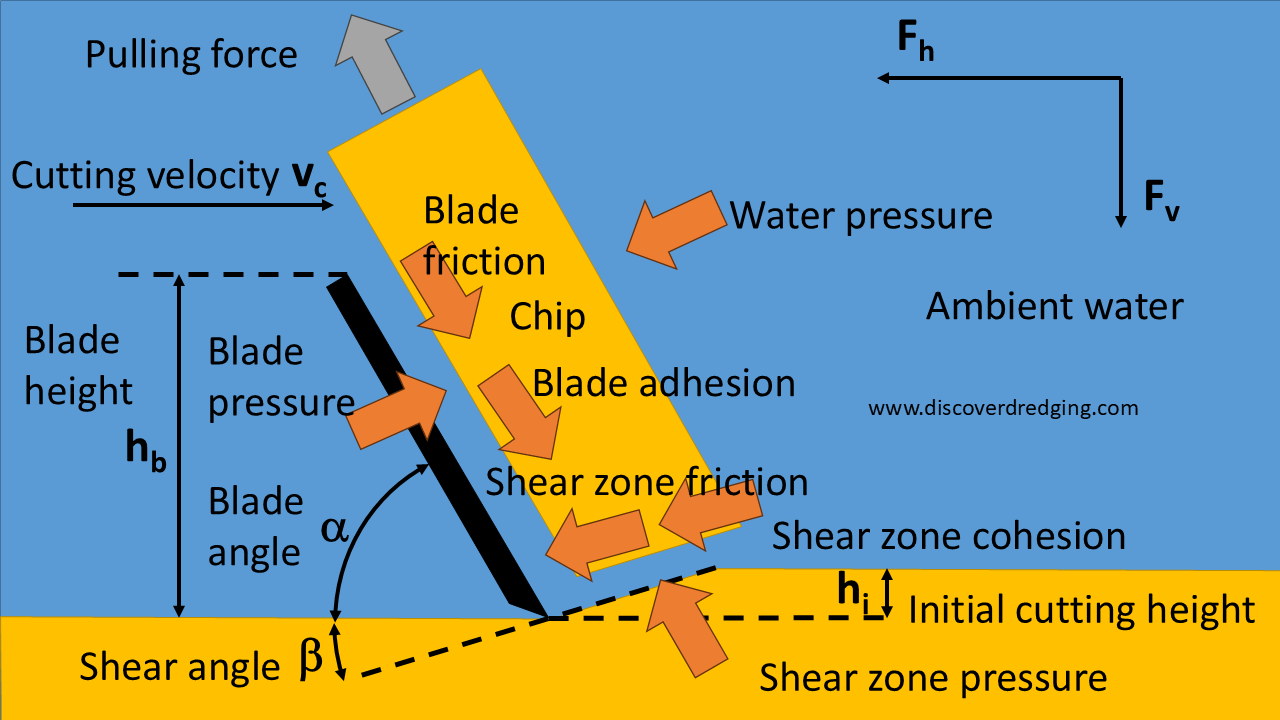
Forces involved in the cutting of clay

We previously found that the forces in the cutting process are influenced by more parameters than assumed in common clay cutting models. Especially the internal and external friction plays a role. Also, the adhesion not always has a fixed ratio to the cohesion. The result of these forces will change the normal forces in the shear plane. Under circumstances the normal force can change in direction. Instead of pushing on the plane, the chip will pull on the plane. Depending on the tensile strength of the clay, the shear plane will tear open and the cutting process transitions to the tear type. The internal angle of friction is a relatively known property of soil. Adhesion and external friction are usually not measured, but are relatively straightforward. The tensile strength of soil is a completely different animal.
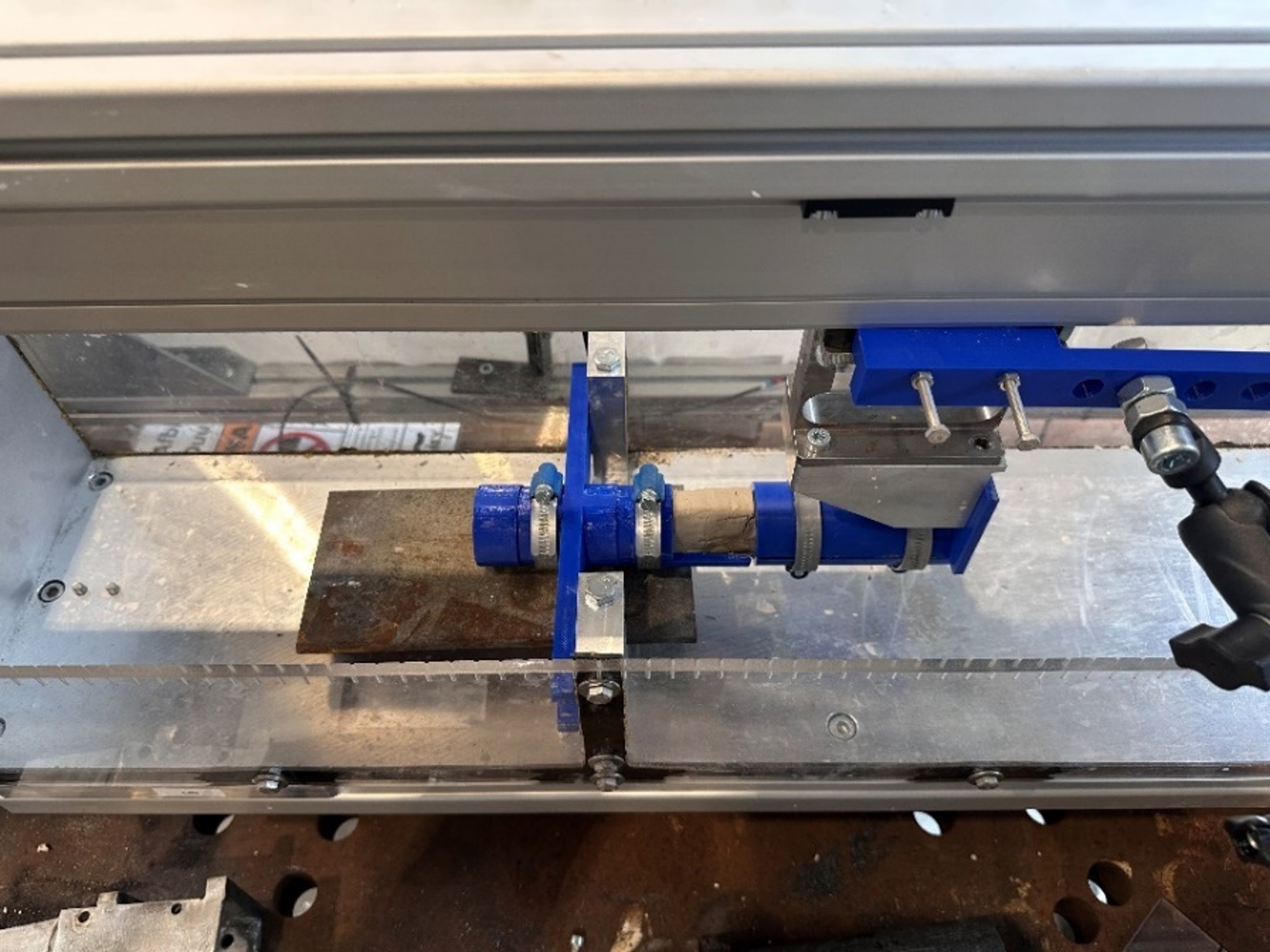
Modified testing rig to measure the tensile strength of clay

Proper civil engineers, like Luc nowadays, are used to putting things on top of other things. And gravity will provide for compressive stresses that keep the soil structure intact. We, as mechanical engineers, are more interested in destroying the structure and we are not afraid on pulling on materials. Civil engineers and mechanical engineers are even using different conventions for Mohr’s Circle. So, Luc had to devise a cunning plan to pull on the clay and find the tensile strength. He modified the test rig and had a special bracket printed to clamp the clay.

Tensile strength depending on the sand content of clay

In order to modify the soil properties of clay, Luc gradually added sand and tuned the water content until the adhesion and the frictions reached the desired values. The resulting wet clay-sand mixture was consequently tested for tensile strength. As expected the tensile strength of the clay reduced as more sand was added. You can imagine that loose sand and no clay does not have any cohesive strength and consequently no tensile strength. Remarkably, there is a sand clay ratio that exhibits a slight local increase in tensile strength. Together with some other finds, we gained more insight in what we can expect of the different soils for the cutting process and how our dredges will perform in those conditions. Next to the usual test outputs, Luc also made some beautiful 3D scans of the resulting chips and block surface. These pictures are a very interesting for my research and will probably the topic of another post.

Luc, thank you for your contribution to my research project.
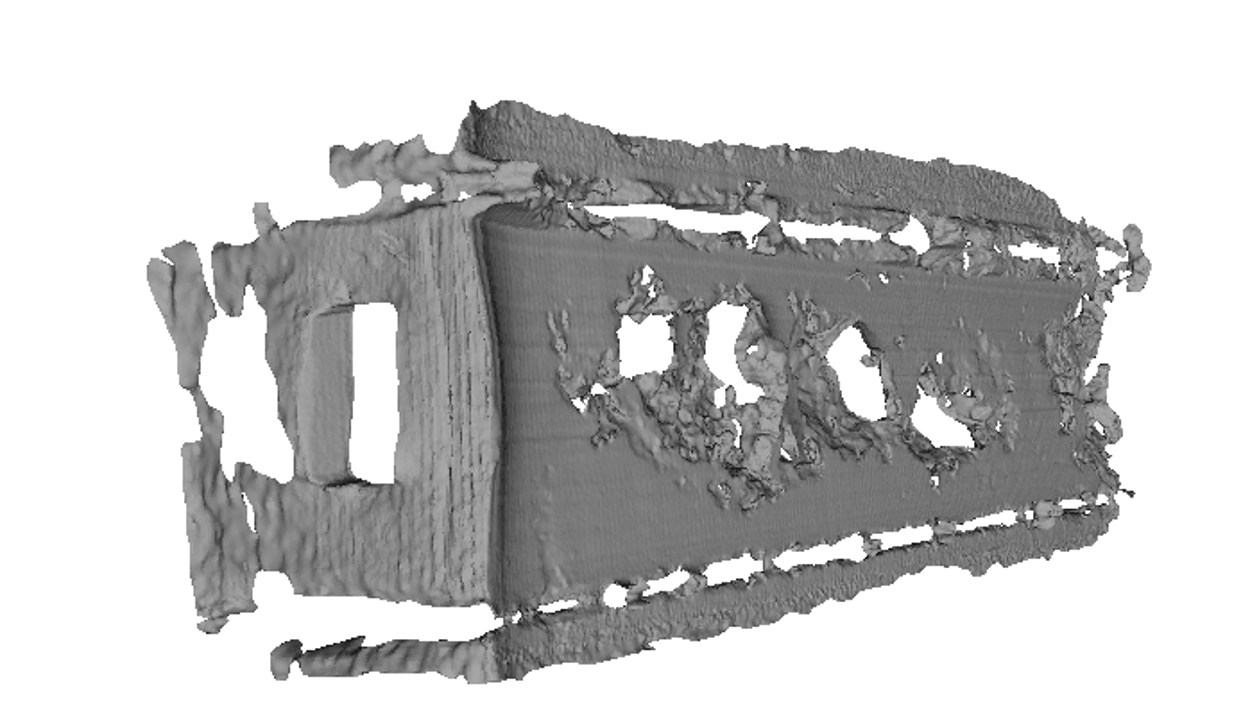
3D Lidar scan of a freshly cut block of clay

References

  1. Tag: PhD Project, Discover Dredging
  2. Graduation Fabian Kruis: Modelling Friction In Clay

Interpore 2026: The Cutting Of Clay in A Herschel-Bulkley Model

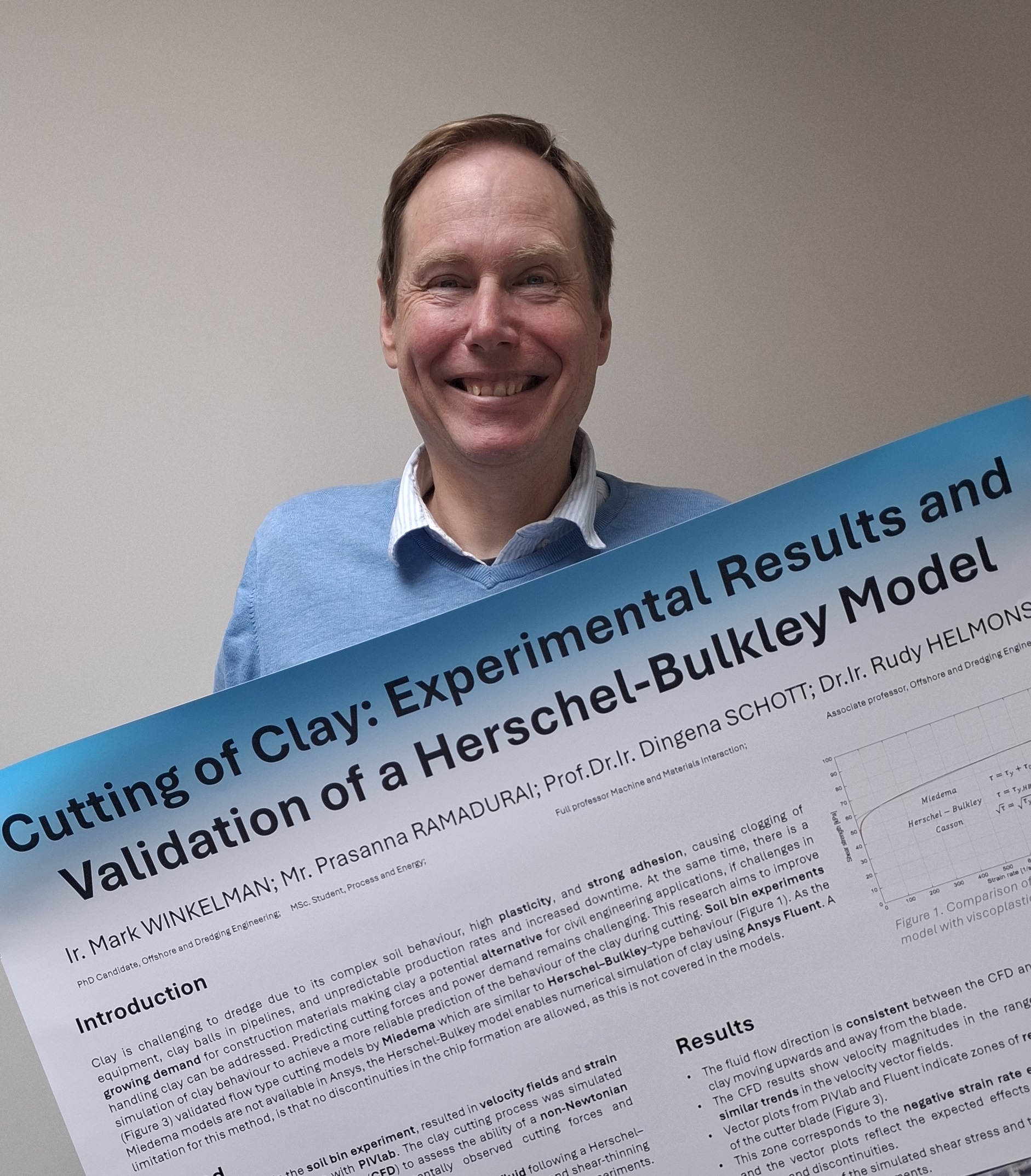
Proudly holding my poster for the Interpore conference

This week, I’ll be in Nantes at the Interpore 2026 conference1. This is an academic conference on everything porous, ranging from catalysts, to food, to foams, to biology and even soil mechanics. And that is a topic where my research fits in. I submitted an abstract for a poster on the work done by our intern Prasanna Ramadurai2 on the applicability of Herschel-Bulkley fluid modelling for the simulation of the cutting of clay. The accompanying presentation can be found here.

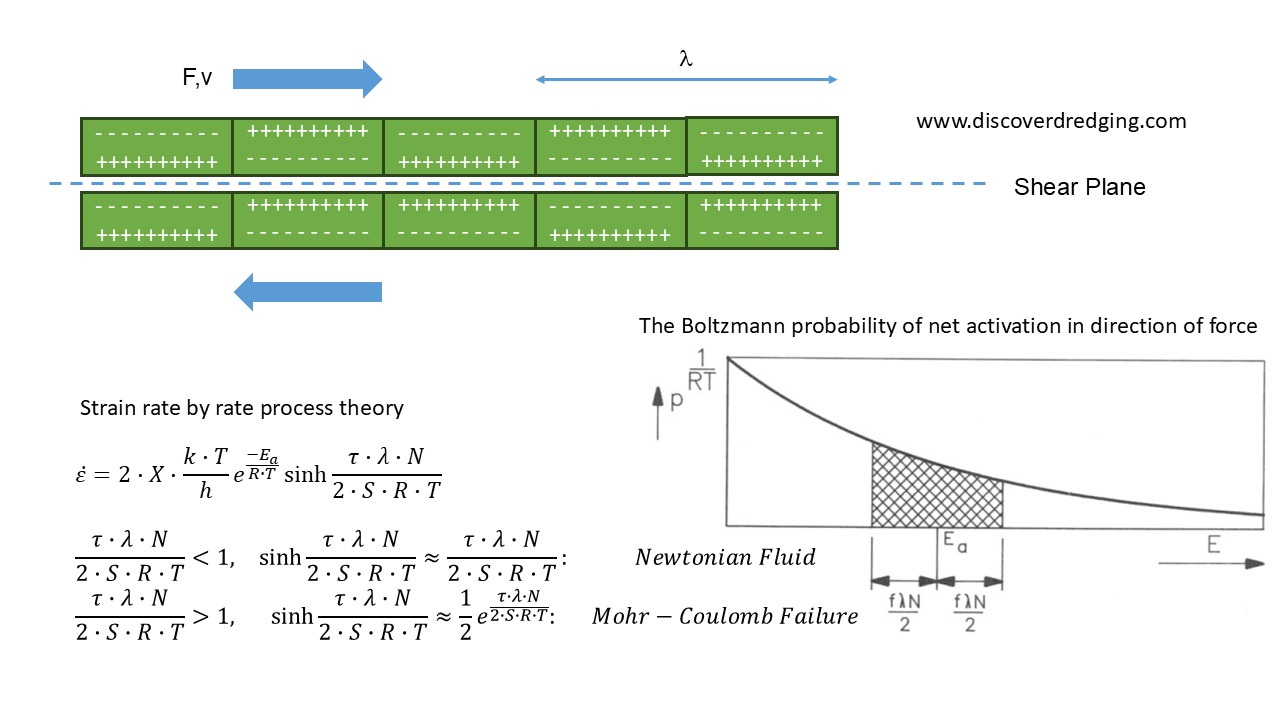
The elemental physics of clay deformation with the rate process theory

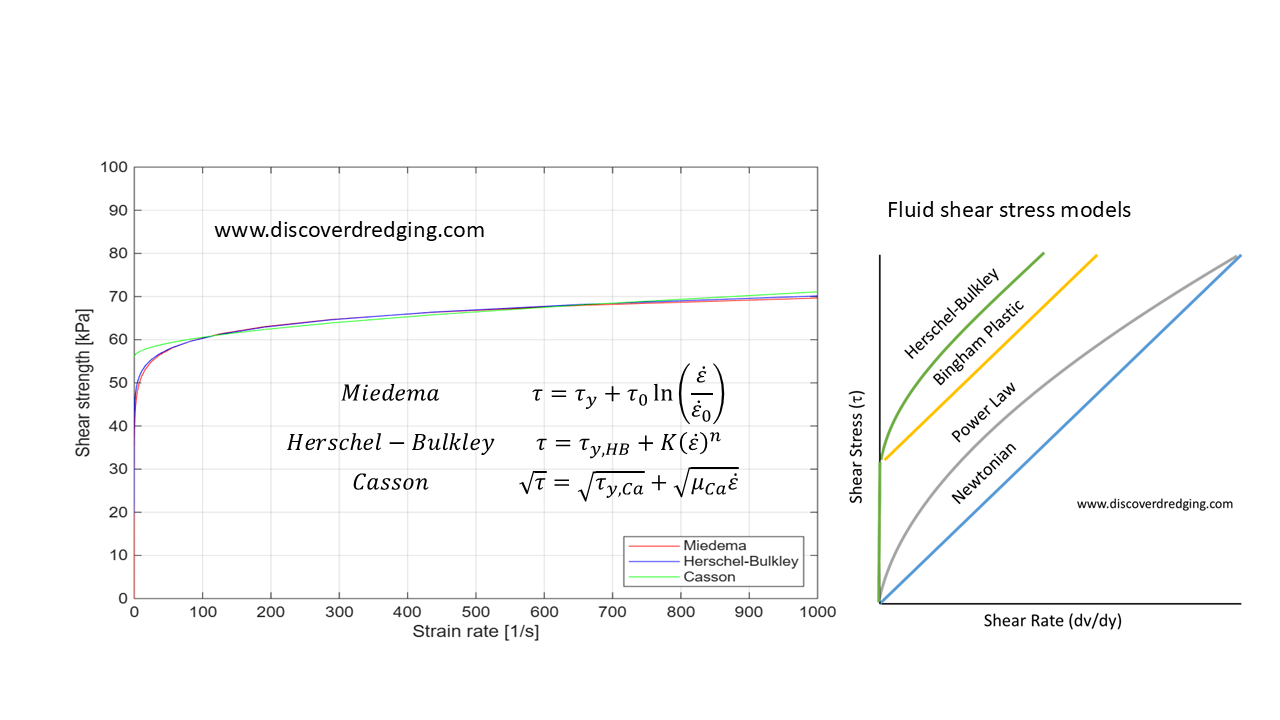
As a refresher, clay is a funny substance. The constituent particles of various minerals that form small plates, that are electrostatically charged. Due to these charges, they tend to cling together. When you deform the mass, there develops a shear plane. The particles move over each other with alternating repelling and attracting electric fields. This discrete path is reminiscent of how in particle physics moving steps are only possible when there is enough energy to push the particle past an activation threshold. This was initially postulated by Boltzmann3 and subsequently formalised by Arrenius and Glasstone in the rate process theory. Miedema further applied this to the deformation of clay4. Depending on the amount of water present, it can behave like the clay can behave like thick water or soft rock. Both captured by the same equations. Eventually the resulting shear stress curve is very similar to a Herschel-Bulkley fluid.

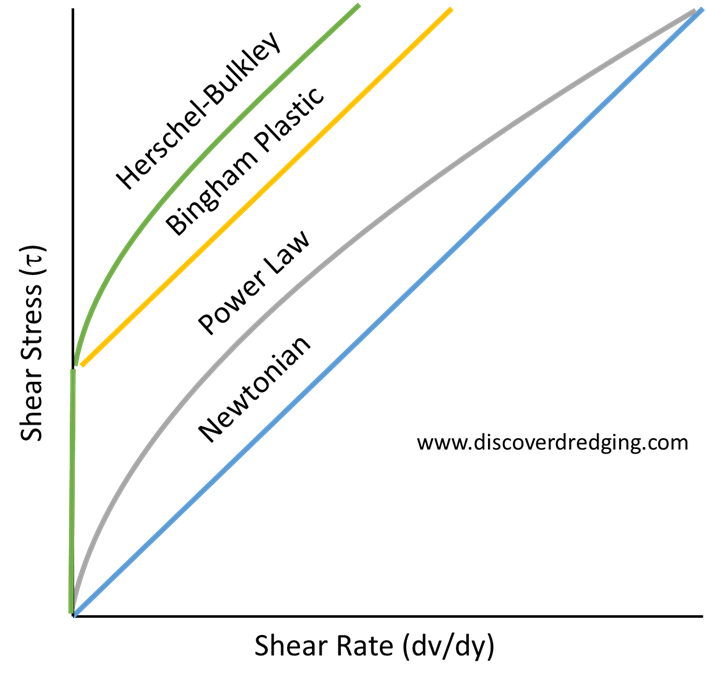
Shear stress model by Miedema and comparable fluid models

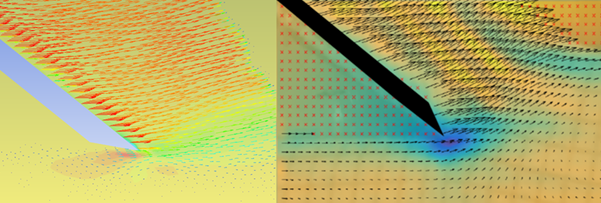
The work of Prasanna focused on exploring a workflow to simulate the deformation of clay using Ansys Fluent for CFD. This package does not support the deformation model as described by Miedema. But, as the resulting behaviour should be similar to the Herschel-Bulkley model, the H-B viscosity could be used. As previously described here, Prasanna managed to find the appropriate settings and setup to achieve credible results.

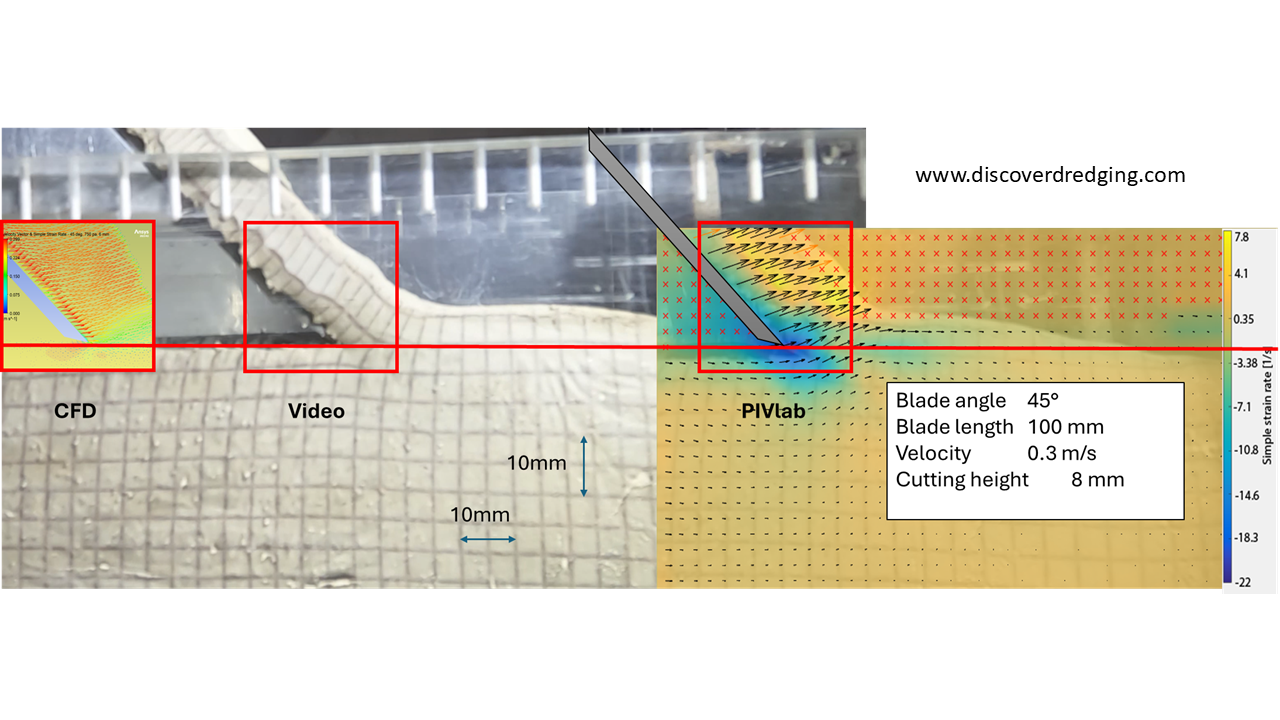
Result of the experiments and the simulation compared

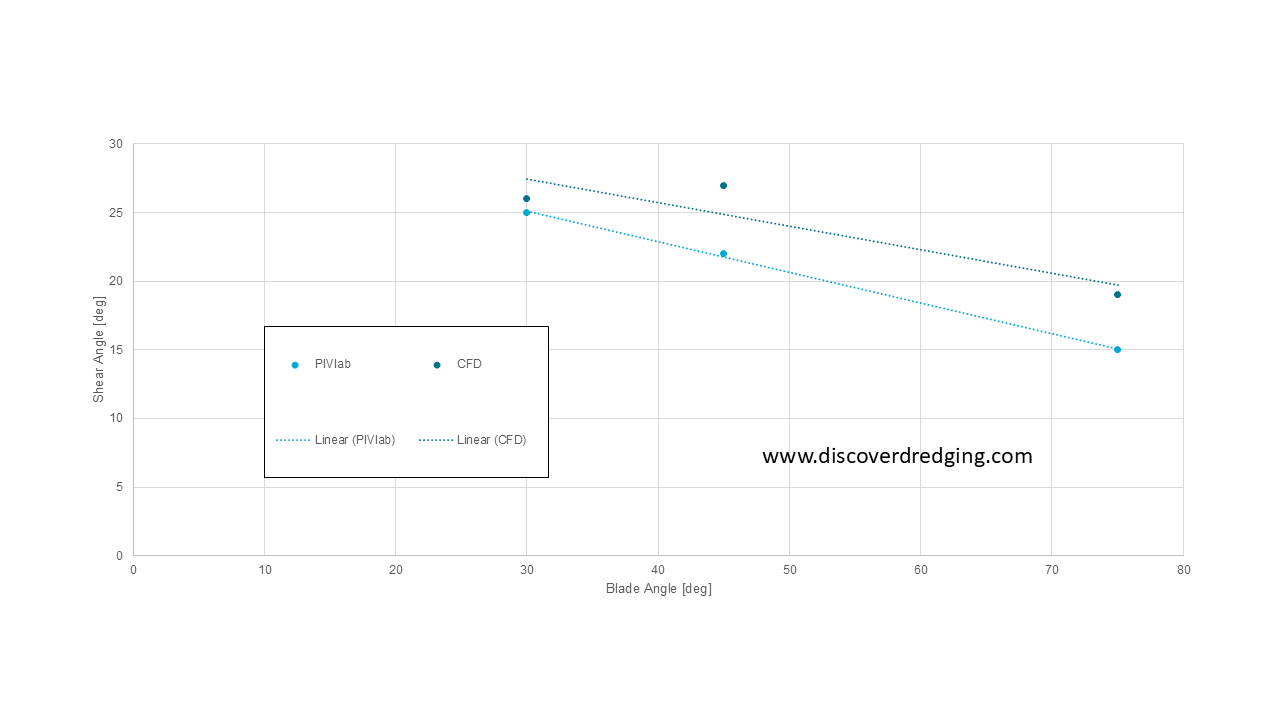
As Fabian Kruis5 has previously done experiments in the soil bin test rig, we do have reference data from actual measurements. Fabian has recorded the deformation and analysed the internal movements with PIVlab. The vector field from PIVlab is very similar to the vector field calculated by Ansys Fluent with the Herschel-Bulkley viscosity model. However, translating the deformation to stresses and ultimately to the cutting forces on the blade is still to be improved. The results from Ansys overestimate the measured forces.

Next to the poster, I also prepared a presentation. This presentation can be accessed through the conference portal, or directly from here. Off course, when you are at the conference, you can approach me there. Or through the contact details her on this website.

Resulting shear plane angles from PIVlab and Ansys

References

  1. 18th Annual Meeting & Conference Courses, Interpore 2026
  2. Internship Prasanna Ramadurai: CFD Modelling Clay as a Fluid, Discover Dredging
  3. Boltzmann constant, Wikipedia
  4. New Developments Of Cutting Theories With Respect To Dredging The Cutting Of Clay, ResearchGate
  5. Graduation Fabian Kruis: Modelling Friction In Clay, Discover Dredging

See also

Internship Prasanna Ramadurai: CFD Modelling Clay as a Fluid

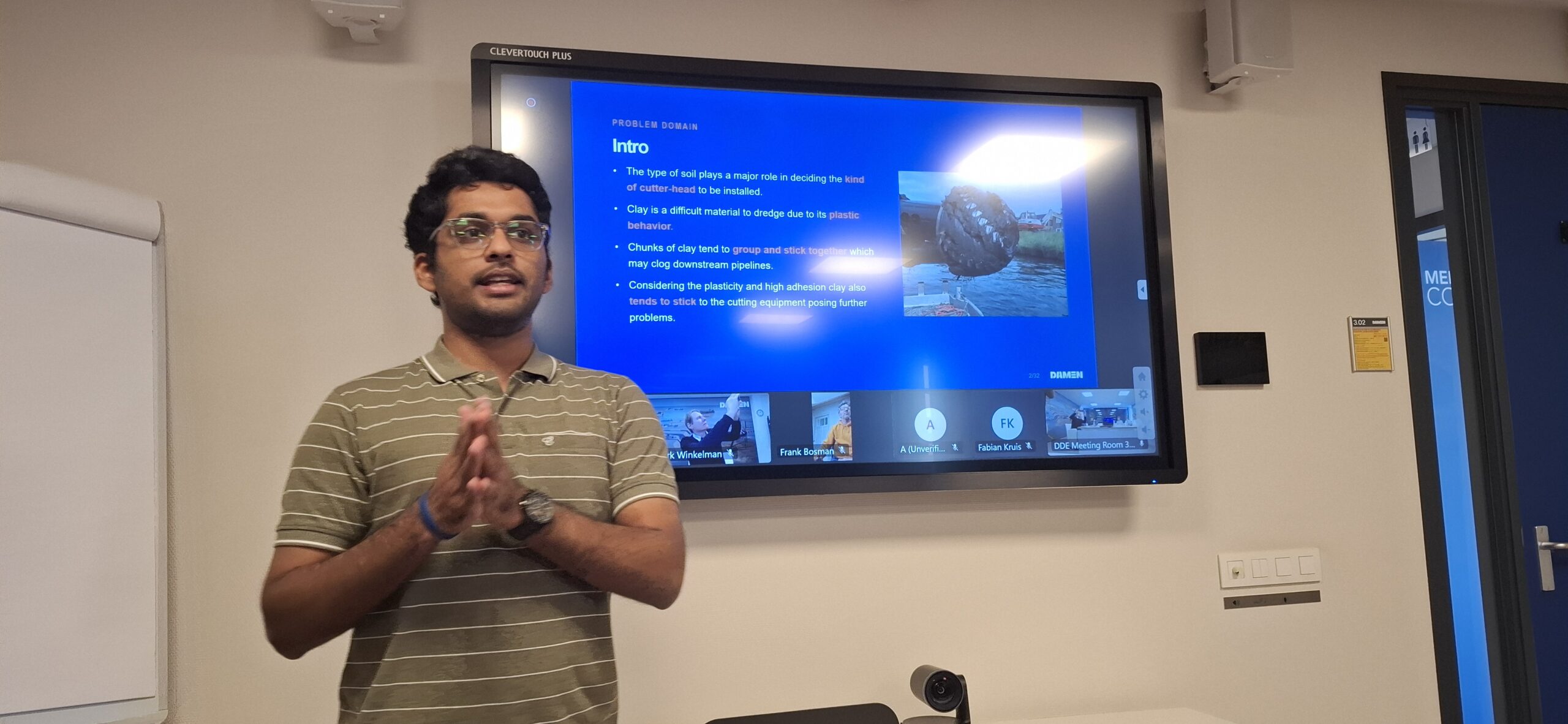
Prasanna presenting his work at Damen Dredging Equipment

Prasanna Ramadurai has been doing an internship with us at Damen Dredging Equipment for my PhD project on the cutting of clay1. As an old fashioned analytical and experimental dinosaur, I have been working in my comfort zone. However, when submitting articles the response from the reviewers has been: ‘How about validating your results with a numerical simulation?’ And that is exactly what Prasanna has been doing for me these months. Now he has presented his work and I can use the results in my own research.

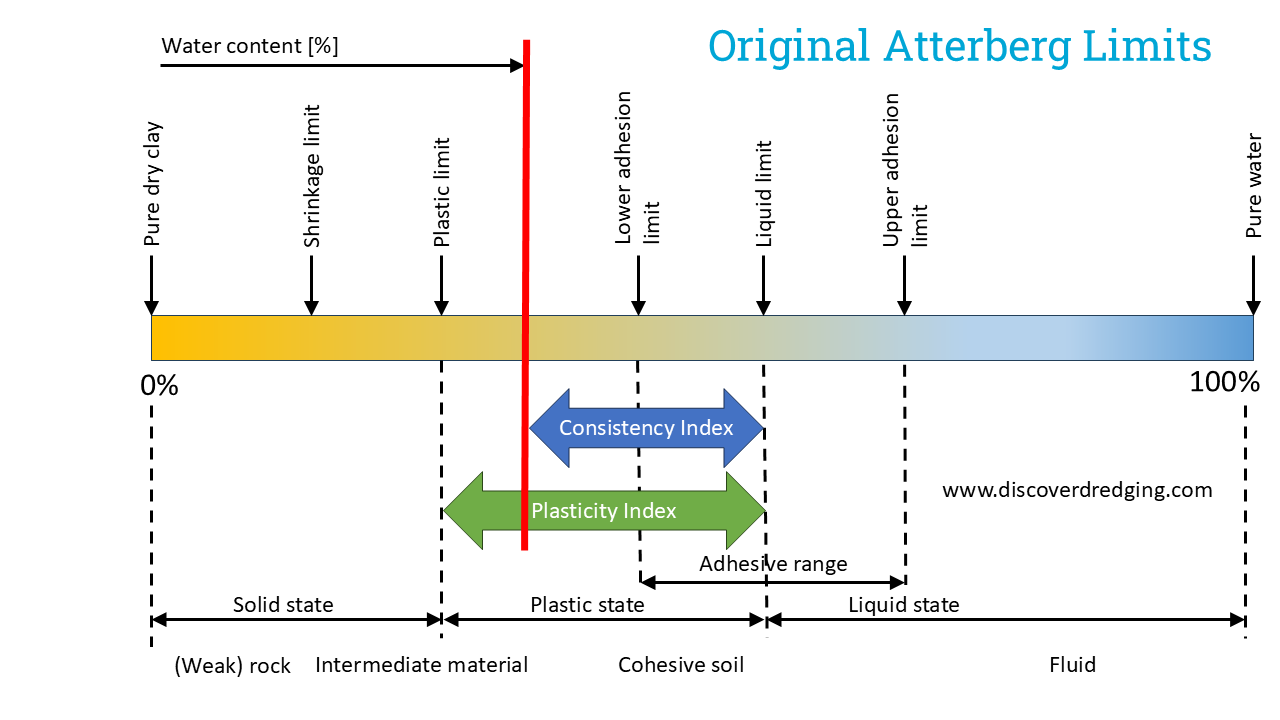
Relation of PI and CI to the adhesion range according to Atterberg

Clay is a strange material. It is neither a solid, nor a fluid. Depending on the amount of water in the material, it can behave like concrete or like water. The scale on which this can be described is defined by the Atterberg limits2. Well known soil parameters as Plasticity Index and Consistency Index are derived from those Atterberg limits. Atterberg himself defined the following limits:

ID Limit name Criteria
1 Upper liquid limit Starts to show signs of a viscous fluid
2 Lower liquid limit Normal Casagrande test or Fall cone test
3 Adhesion limit When no clay sticks to a nickel spatula
4 Upper plastic limit Can be moulded
5 Lower plastic limit Normal rolling test for plastic limit*
6 Cohesion limit When pieces of clay do not stick to each other anymore
7 Shrink limit Normal shrink limit, constant volume for water content
*Atterberg proposed to roll on a paper surface, whereas ISO 17892 proposes a glass plate

The consistency limits as originally proposed by Atterberg

The resistance of a material to deformation can be expressed as the resulting stress due to a strain rate. When there is immediate stress for even the slightest movement and constant after reaching a yield stress, this is typical of a solid. On the other hand, when a material starts to move immediately and the resistance to deformation increases with the strain rate, it is a fluid. And clay is just the typical material that exhibits both phenomena.

Shear stress models depending on strain rate

In rheology, the factor which shear stress is related to the increased strain rate is called viscosity3. However, due to the internal friction in clay, the stress follows the vertical axis and consequently, the viscosity becomes infinite. Prasanna squeezed out the capabilities of the CFD program using some clever mathematical tricks of a Herschel-Bulkley fluid model to get the simulation to behave. And the results are promising enough to follow up in a separate study.

Compare CFD simulation and PIV experiments

For supervising Prasanna, I am very grateful for the assistance of Suman Sapkota for his knowledge of computational fluid dynamics. Together with my knowledge of clay, Prasanna gained a very special set of skills in this area. Prasanna will be back at the TU Delft to continue his master’s graduation project. I can recommend him for having him in your team.

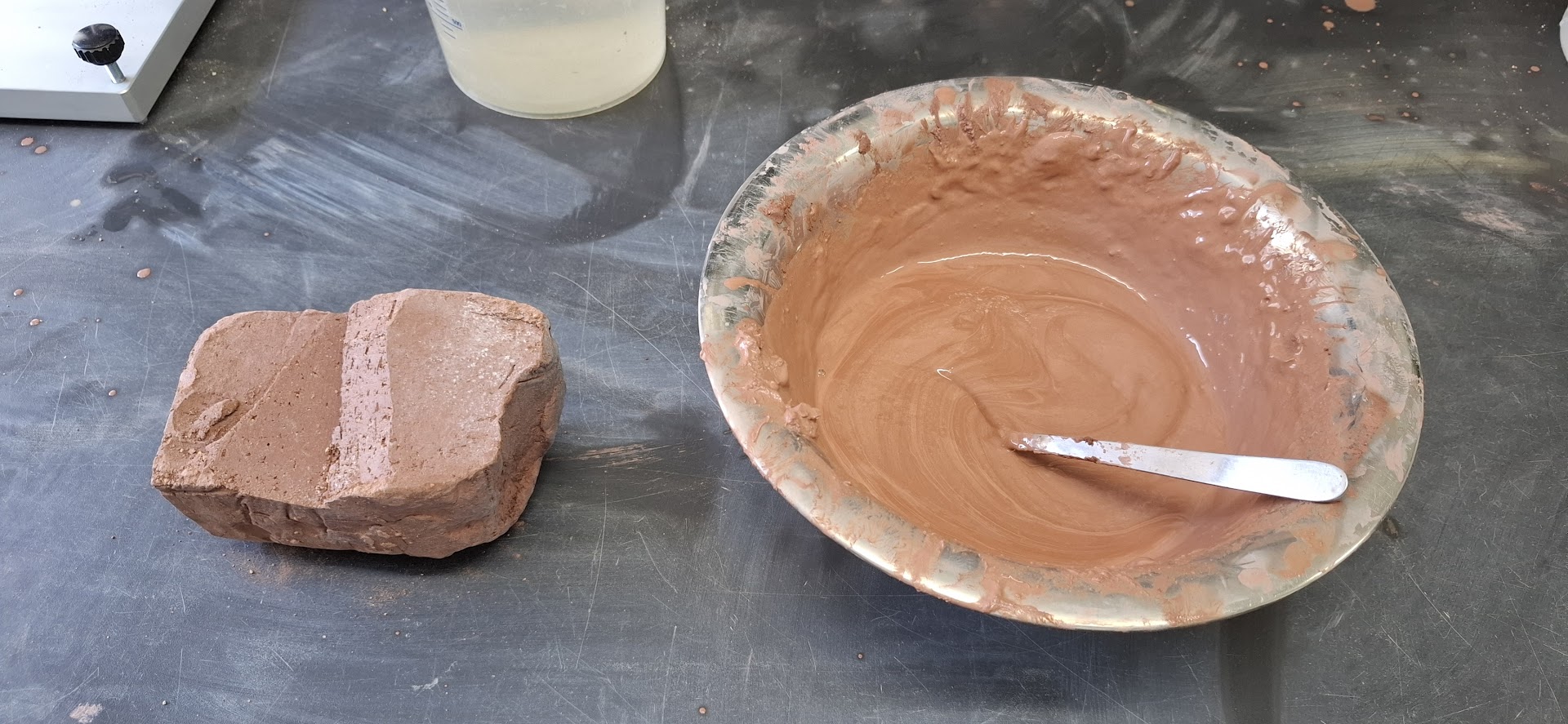
The same clay in solid and fluid form

References

  1. My PhD project posts, Discover Dredging
  2. Atterberg limits, Wikipedia
  3. Viscosity, Wikipedia

See also

Prasanna Ramadurai, LinkedIn