Working Group ‘Sand’ Visits Damen: Perspectives On Sand From Micro to Macro Scale

Working Group ‘Sand’ visiting the Dredging Experience at Damen Dredging Equipment

You may already know, that I am very interested in this miniscule particle that is the foundation of our business. To learn more about this element, I joint the Working Group ‘Sand’ of the Dutch Association for Geological Activities1. It is a colourful group of enthusiasts that collect, photograph and research sand in all its splendour. During the relaxed Saturday afternoon meetings, the members gradually noticed, I had a slightly different, professional interest in sand. They boldly asked if they could visit our company for their annual excursion. Maybe my presentation, by at least the excellent weather made for a very successful event.

Measuring the grain density of sand

One aspect of the sand grains we wanted to measure was the buoyancy of the particles. This is done by measuring the density of the grains. You have a tube of water with a known volume. You add sand with a known mass. And just as Archimedes2 predicted, the water will rise with the displaced volume of the grains. Dividing the mass by the displaced volume yields the density of the grains. Surprisingly, this method is quite accurate. For a static condition this is perfectly satisfying. However, in most dredging situations, the grains are dynamically jostled around in slurry transport or breaking up sediment at the cutter.
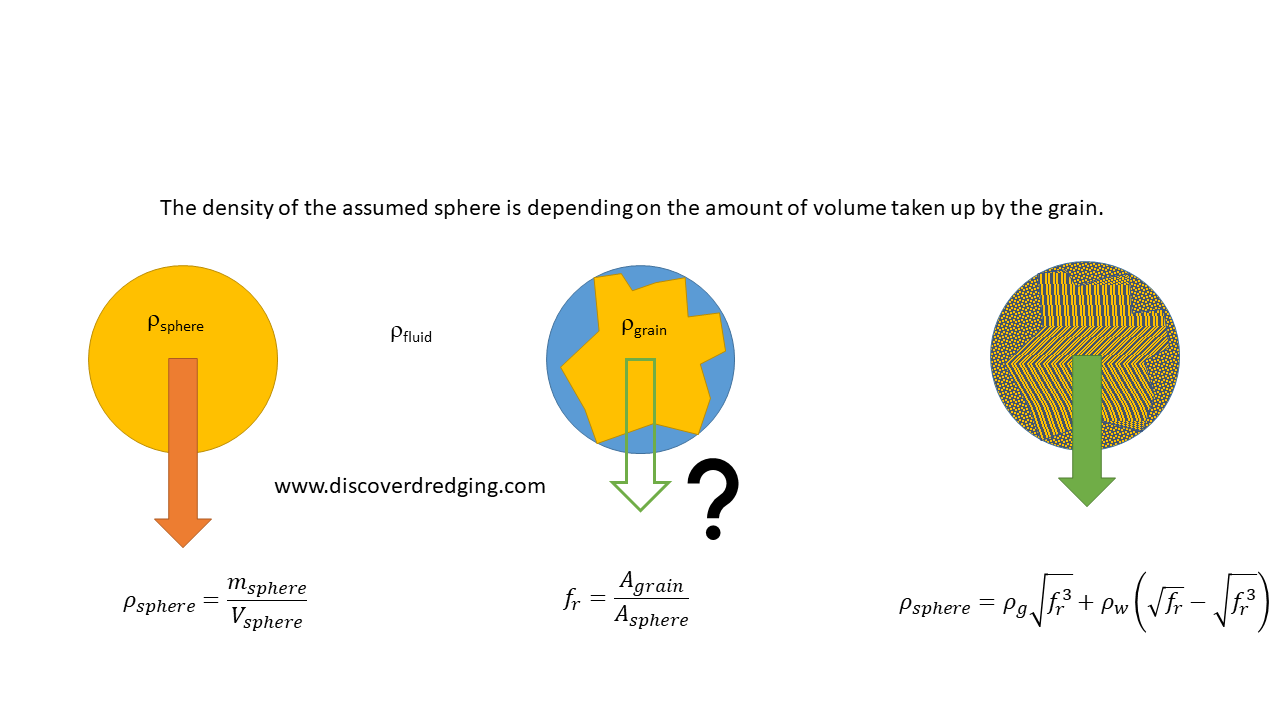
Effective grain density due to adherent fluid

When a solid grain is moving through a fluid, it is usually considered as a perfect sphere. Nothing is perfect in nature and grains do have a range of shapes, that at best are similar to potato’s. A very jagged grain will have lot’s of nooks and crannies filled with the fluid. This fluid is moving with the particle and contributes to the mass and volume of the particle. This adherent fluid is much more reliably assumed to be a sphere. Fluids in a zero gravity situation tends to behave like a sphere. The diameter of the sphere can be taken as the maximum diameter of the grain that can be measured.

Measuring the effective volume of sand grains

Through a microscope, you will only be able to see the lateral area or the cross-section of a grain. Both area and volume have a relation to diameter. So, the measured area is reduced to an equivalent round area with an equivalent diameter and consequently an equivalent volume. The volumes and masses of that equivalent volume of sand and the shell of adherent water will yield an apparent density of the moving particle.

Effect of apparent density on dredge performance

In the end, my objective was to learn through the microscope the effect the shape of the sand had on the performance of our dredges. As seen in a calculation in our production estimating program, the effect can be significant. Certainly an influence we want to know and assist our customer with appropriate advise3. My visits to the meetings of the Working Group ‘Sand’ were a real benefit in understanding sand. But, to my surprise, through the working group I also learned to appreciate the beauty of the all the different sand minerals that can be found.

Picture of various sand grains in an interesting mixed sample

References

  1. Werkgroep Zand, Stichting GEA
  2. Archimedes, Wikipedia
  3. In house R&D Department, Damen Dredging Equipment

See also

Digital Microscopes, Dino-Lite

Graduation of Ines Ben M’hamed: The Strength of Clay in a Test Rig

Ines Ben M’hamed defending her graduation thesis

Last week, Ines Ben M’hamed graduated with good grades on her bachelor thesis. She did a project with us at the Research Department of Damen Dredging Equipment in Nijkerk. The topic was to investigate the strengthening of clay when it is subjected to shear. This deformation is a common phenomenon when cutting clay and as such a contribution to my own PhD project1 and consequently improving our products for these applications. A common problem with clay is clogging up the cutter head, but it is also not completely understood why the clay is behaving as it does and how much power is involved for the various regimes.

Fully covered cutter head in sticky clay

The effects of deformation on the behaviour of clay are much more pronounced than e.g. sand or rock. Rock does not deform, it just breaks. Sand deforms, but as it basically only involves hydraulic and mechanical forces, it is much better understood. Clay particles have wider range of interactions. Next to the hydraulic and mechanical forces, they may experience: adhesion and cohesion, molecular forces, electrostatic charges and chemical bonding in the higher temperature ranges. The general effect is that as the particles in the original situation may have a weak structure, the external disturbance causes the particles to get jostled around and all the mentioned interaction get a chance to hook on to each other.

Shear strengthening due to organising particles

The result is, that the particles get oriented and therewith a better opportunity to bond. The effect is a strengthening of the shear stress. As this strengthening is dependent on the strain rate, it is this strain rate, that is of interest for the prediction of the cutting forces. There are many publications available on what the consequences are of the strain rate on the Specific Cutting Energy. A well known model is by Sape Miedema2.

Strain Rate Effect on the Specific Cutting Energy (Credit: SA Miedema)

The trick with this model is, it depends on this strain rate effect. The sole experimental data available is by Hatamura and Chijiwa3 in 1975. They tested one type of clay on the three governing parameters: static shear strength, dynamic shear strength and the strain rate. There hasn’t been hardly any further experimental investigation into this problem. And as we regularly receive samples and soil reports that we can not test on these properties, it is also hard to predict the performance of our cutter heads. So, we decided to build our own cutting test rig.

Design of Ines’ cutting test rig

This cutting test rig resembles the specifications to the original test rig of Hatamura. This will allow us to verify the parameters in the model ourselves. We also prepared the design with various option to enable us to allow assessment of clay samples that we receive from clients and service engineers. We hope to provide our customers with additional service in this problem. Currently, the parts of the test rig arrived very late and Ines was not able to include the build in her project. Respect for the good grade she received for her thesis. However, the parts are there and provide and excellent opportunity for the next graduation student to do their project with our company. Who dares?

Available parts for the cutting test rig

References

  1. Personal Announcement: Going Back To School To Cut Some Clay, Discover Dredging
  2. The Delft Sand Clay & Rock Cutting Model, SA Miedema
  3. Analysis Of the Mechanism of Soil : 1st Report. Cutting Patterns of Soils, Hatamura & Chijiwa

See also


Graduation Of Alex De Rooij: Pumps Actually Fly Like An Unusual Airplane

Alex de Rooij receiving flowers from Suman Sapkota for his graduation

When you hire a carpenter, he repairs everything with a hammer. So, what happens when you ask an aeronautical student to solve some issues in a dredge pump? He models the pump as a badly behaving airplane. And with success, Alex de Rooij joined our company as a graduation student and recently graduated on the topic of ‘Numerical Study on NACA Profiles Sensitivity in Dredge Pump Impellers’.

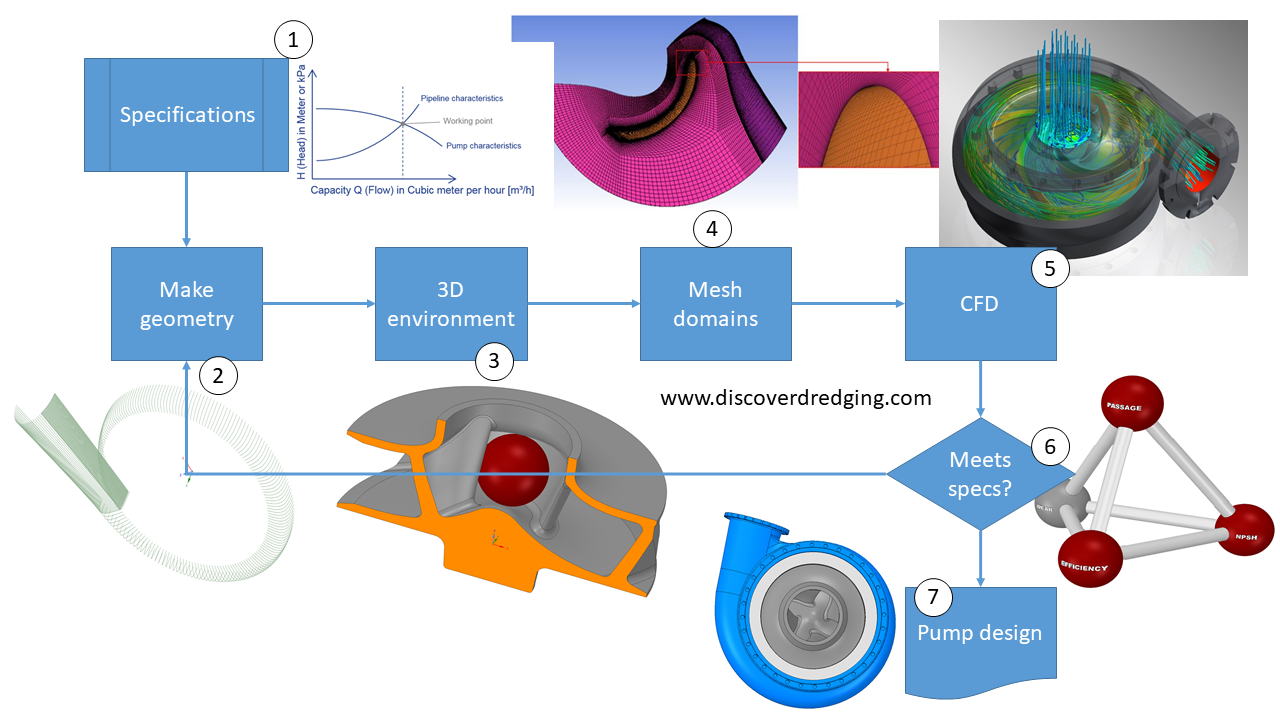
The normal procedure for designing pumps is relatively straight forward. Set the performance specifications and try to hit that mark with the simulated behaviour from an iteratively improved design. This is well documented and I’ve been writing about this process before.1

Pump design workflow (inspired by Suman Sapkota)

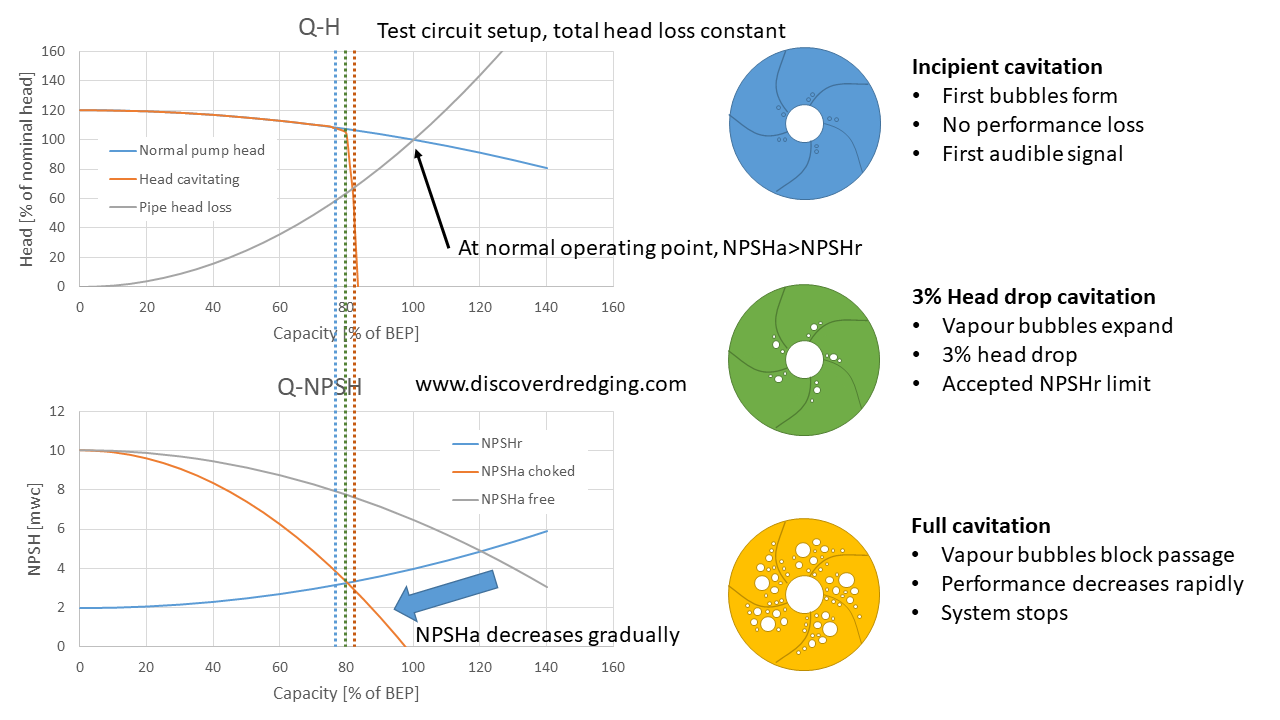
One of the design parameters is the NPSHr. This is basically the amount of absolute pre-pressure the pump requires to operate.2 The system and operating conditions will result in a certain available pre-pressure: NPSHa. When the NPSHa drops below the NPSHr, the pump will experience cavitation at the low pressure side of the blade. The flow of the medium will be disturbed and the performance of the pump will abruptly crash. There is some warning. Operating near the NPSHr, there will be an incipient cavitation where the vapour bubbles start to form, but do not cause any issue. The imploding vapour bubbles may be detected audibly for the trained listener.3 Next will be a stage on the NPSHr, where the bubbles get larger and they loudly implode. At this stage, the pump sounds like it is tumbling nuts and bolts inside. These imploding bubbles will definitely cause damage to the impeller. At last, working below the NPSHr, the bubbles will become so large, they will block the passage between the blades. The result is an immediate drop in delivered head.

Explanation of NSPHr, NPSHa and cavitation

The flow of the medium through the impeller can be simulated in a CFD program. Specifically for impellers, you will need to model a rotating frame of reference. And that is the usual representation of the results. However, with mathematics being one of the most powerful tools invented by humanity, we can have an alternative view on these results. We can cut the impeller along a radial and stretch open the meridional passage and the blades to a row of foils. And that is exactly where our young aspiring engineer comes in. In literature, the blades in the impeller are modelled having a constant thickness. But, Alex has been investigating what the influence will be when we model the blades as foils. Selecting a proper profile makes the blade less sensitive to stalling.

Conversion of axial view to blade to blade view

Alex, thank you very much for your work here at Damen. We’ve learned the influence of certain profiles on the performance and geometry of the pumps. You have the right mindset to pass your time at the TU Delft and graduate successfully over there also. And whenever you have some days of the month left after you spend your allowance, know that we can give you a warm reception at our office.

Alex working at the reception desk at Damen Dredging Equipment

References

  1. Our Interview About New Pump Designs In The Latest Damen Nieuws, Discover Dredging
  2. When does your pump suck? Discover Dredging
  3. Cavitation in a Water Pump and Valve, Mountain States Engineering and Controls

See also