Young CEDA Visits Damen Dredging Equipment

Group picture of the Young CEDA visit to Damen Dredging Equipment

CEDA has always been an advocate of sharing and disseminating knowledge, with an attention to personal contacts1. Of course, there are the high profile Dredging Days2 and the WODCON3 level events, but once in a while there are also smaller events. As part of the smaller program, Young CEDA4 regularly organizes visits at projects and companies to bring together the new generation of our dredging community. This time, a group of young professionals visited our company Damen Dredging Equipment here in Nijkerk5 to get familiar where we are and what we do. Rick Bekkers, Jorgen Groeneveld, Suman Sapkota and Reinier de Vries where hosts of the event and organised, with assistance of the ladies of our reception and back-office, a nice program with presentations a yard tour and of course drinks and the proverbial ‘bitterballen’.
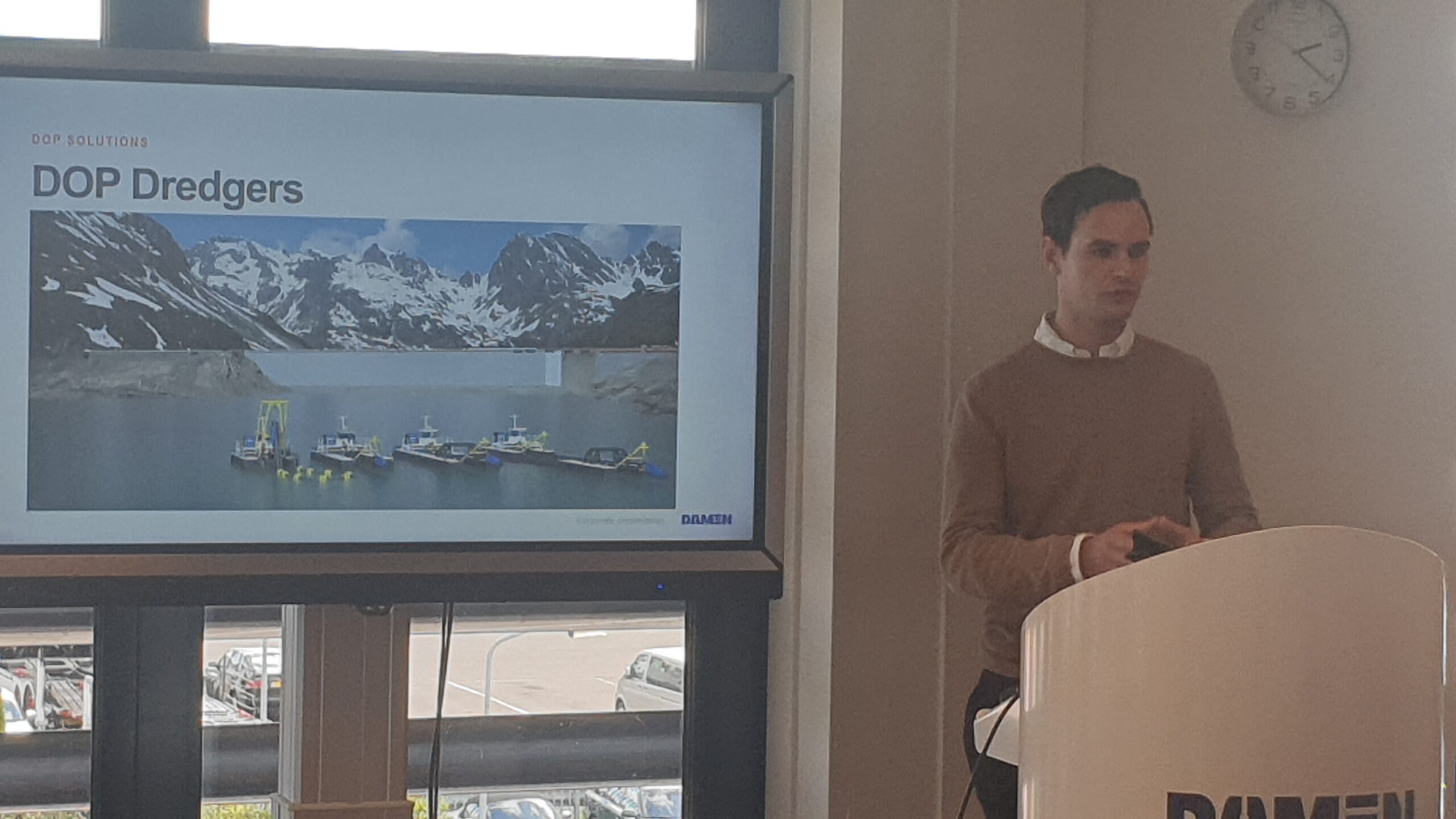
Rick Bekkers giving a presentation on DOP dredges

After Rick and Reinier gave a presentation on the premises and the products, there was a yard tour and a demonstration of our dredging simulator by Wouter Beekman. And I am always happy, that the visit to our Damen Dredging Experience was a great success again. We do have our own little museum to experience the difficult issues in the dredging process hands-on6. Literally! Specially for this occasion, the exhibits have been expanded with new informative screens, made by Judith Korver. In a few slides there is an explanation on what the visitor experiences by operating the exhibit.
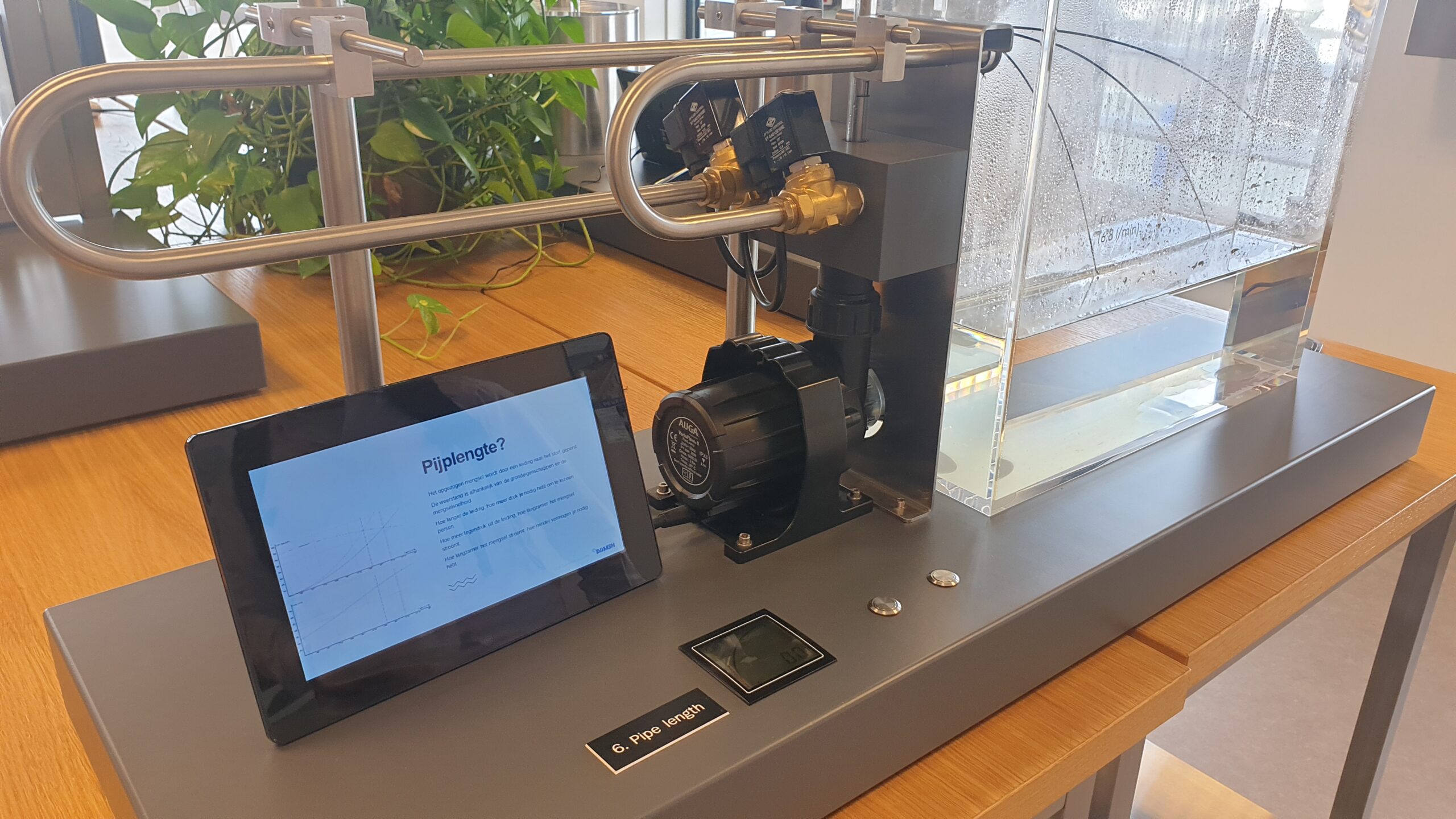
Informative screen at the pipe length exhibit

Part of the experience is the staircase leading up to the third floor with the exhibits. In the staircase, there is a collection of wall covering pictures on the history of Damen Dredging Equipment. Personally, I think learning from history is essential to get inspired7. Back in the old days, people had to be very innovative to come up with solutions within their limited technological level. And Mr. de Groot, the founder of our local Damen company was very innovative8. He was the inventor of the double walled dredge pump9 and the soil pumping station10.
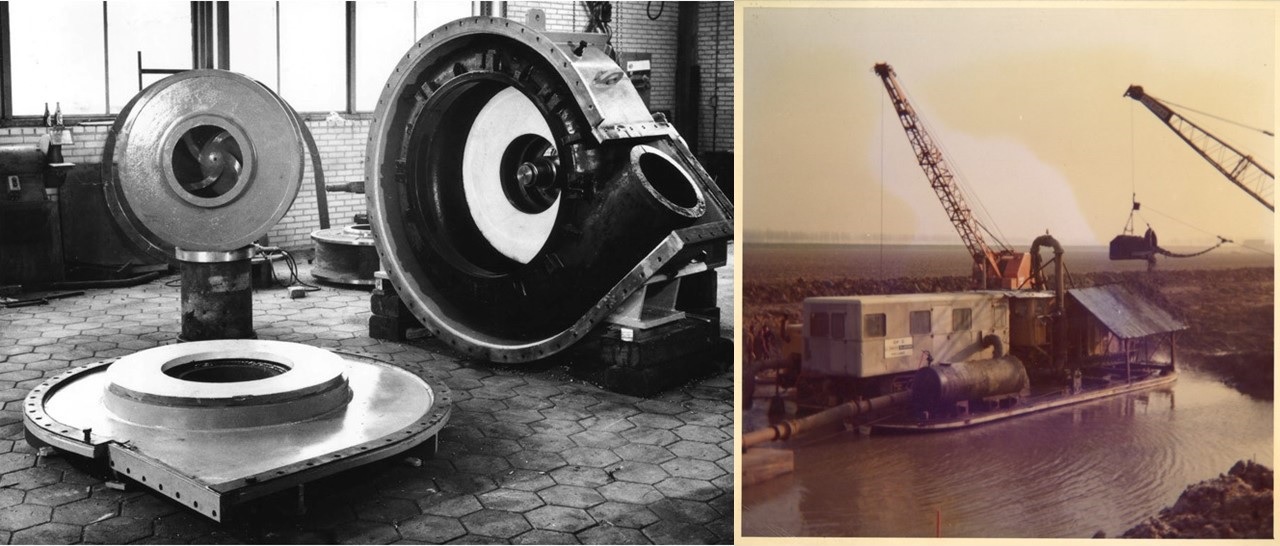
Double walled dredge pump(l) and soil pumping station (r)

A lesser known fact by now may be, that originally Mr. C de Groot was a contractor. He was a true descendant from a Giessendam dredging family and tried his luck at the IJsselmeer werken of the 1930’s. As a basecamp, he leased a land lot next to the sea locks of Nijkerk. Later on, he had more fun on building his own equipment and eventually started a manufacturing facility more inland along the approach canal. You can still recognize the original footprint in the current urban landscape.

Arial view of the original area of Damen Dredging Equipment
Arial view of the current area of Damen Dredging Equipment

At retirement, Mr. de Groot had no successors and had to sell the company. After an intermediate period, De Groot Nijkerk was acquired by Damen Shipyards8 in 1988. Eventually in 2004 our company was rebranded to Damen Dredging Equipment and we proudly fly the blue colours of the Damen family.
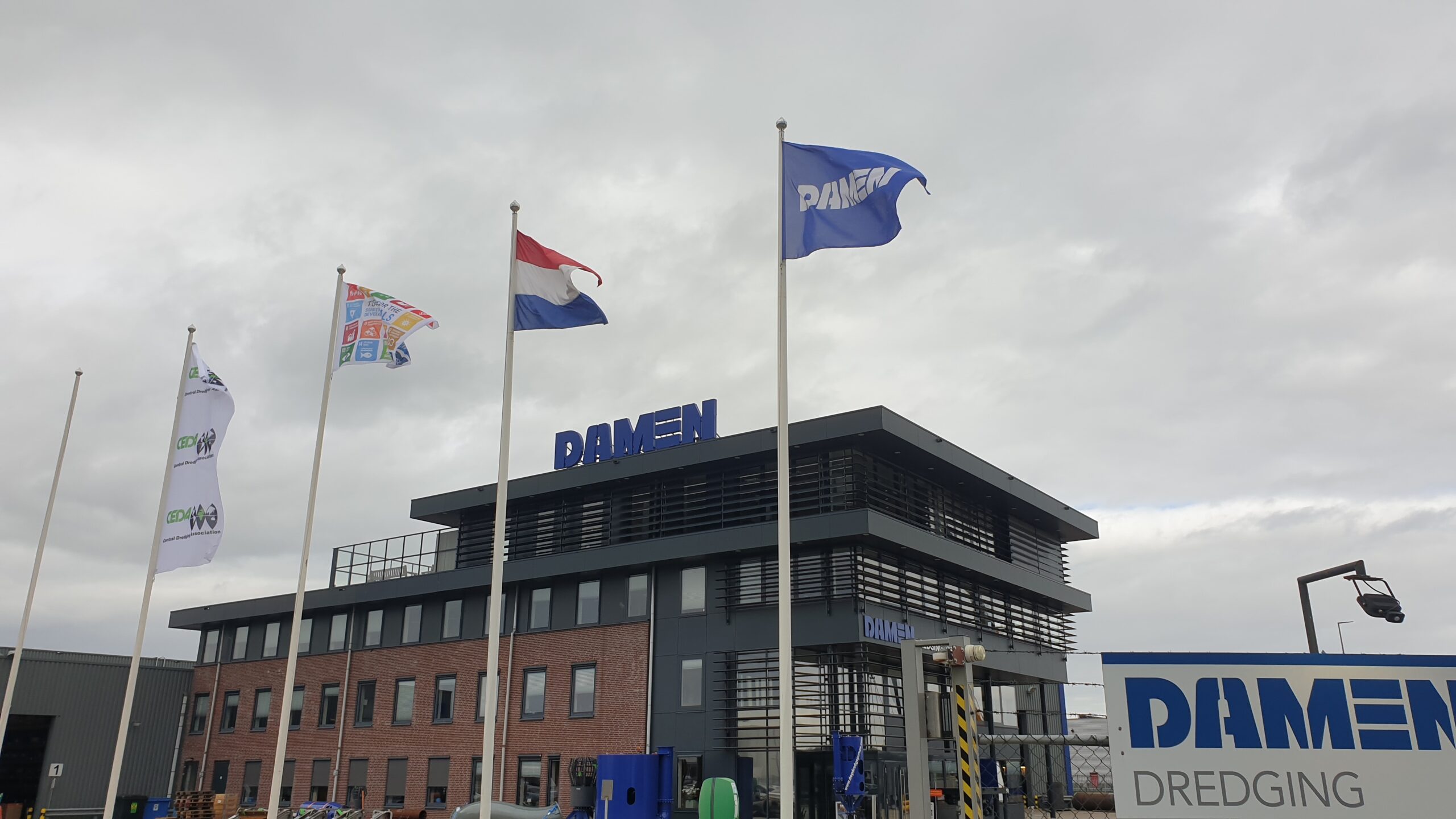
Flags welcoming visitors at the entrance

References

  1. Our Mission, Vision and Strategy, CEDA
  2. About CEDA Dredging Days, CEDA
  3. WODCON’s, WODA
  4. Young CEDA Meetings, CEDA
  5. Young CEDA Site Visit Damen Dredging Equipment, Nijkerk, CEDA
  6. Experience the Dredging Experience, Discover Dredging
  7. Welkom in het Nationaal Baggermuseum, Nationaal Baggermuseum
  8. A long history in dredge building, Damen
  9. How to dress your dredge pump for success, Discover Dredging
  10. Book Review: En De Sé Wie Net Maer, Discover Dredging

See also

Listen To The Pump Master, His Story Never Wears Down

Example of a worn impeller at the Damen Dredging Experience

This week is the triannual WODCON conference1. This edition will be held in lovely Copenhagen, in itself already a reason to be there. But there is more, the program is packed with interesting items. Starting with the opening ceremony with the Danish minister of transport and the Corporate Executives Discussion on sustainability. The Fehmarnbelt Tunnel Link will be a hot topic all through the program. My personal suggestion would be to attend Session 4: ‘Hydraulic Transport’ on Tuesday 17. Two of my highly regarded colleagues will be presenting their work on very interesting topics.

Damen colleagues present at the WODCON 2022, (l) Rick Bekkers, (r) Suman Sapkota

Rick Bekkers has been involved in the development of our new ProDredge edition. It is a slurry transport estimation tool. Where Ewout van Duursen has been working tirelessly on programming the tool, Rick has been checking the models and the results against known literature. He will show you the new reports generated and the insights they will give you for evaluating a proposed dredging system.

ProDredge presentation of a dredging system to be evaluated

Suman Sapkota will be presenting his favourite topic: ‘Erosion estimation on the impeller blades of centrifugal dredge pumps’. He has been working on this topic ever since his own graduation project.2 Over the years he spend pondering over this issue and gradually grew in experience with the problem. Based on his ideas, he managed to start a cooperation with the Delft University of Technology and have a master student working on the practical details of his plans. Previously, I’ve written about the graduation of Wim Kleermaker in another article.3

Wim Kleermaker during the practical phase of his graduation in dredging

Suman has been concentrating on gathering the various models for wear under different conditions during his own graduation. The results from his simulations could only be checked against my own experience with badly worn impellers and disasters. Immediately introducing observer bias and survivor bias. So, for this project Suman really wanted to include experiments to have at least one observation to match the simulations.

Damen slurry test circuit with dredge pump and impeller

And what a struggle it was, to get the experiments done. Wim really gained more experience in fixing troubles than in fact finding. In the end he managed. After operating for a couple of weeks under heavy load conditions for the dredge pump, the impeller showed a noticeable wear pattern. And they came up with an innovative way of measuring the erosion pattern and match the test results with the simulation results.

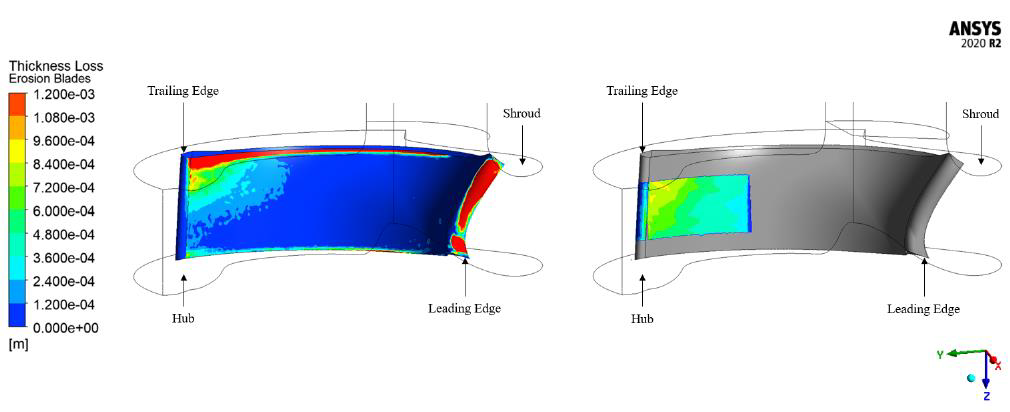
Comparing CFD results (l) with measured erosion (r)

The paper Suman is going to present on the WODCON, condenses the results from Wim together with Suman’s previous work as a graduation student himself. Don’t get deterred by the in depth analysis. If you fancy, you can follow the comprehensive literature references and understand his model. Or, just enjoy the ride and inspect the interesting pictures with the conclusions at the end. If you are really interested in his work, just approach him in the break hours, he is very willing to share his experience with you.

If you can’t find him, or Rick. Drop by at our booth #27 in the lobby.4 There will always be someone to get you into contact.

Damen invitation for the WODCON 2022

References

  1. WODCON 2022, WODA
  2. Graduation Suman Sapkota: Where Wear Parts Were Worn Down, Discover Dredging
  3. Graduation Of Wim Kleermaker: Measuring And Predicting Wear In Impellers
  4. WODCON Dredging Conference, Saskia den Herder

See also

Second Thoughts On The Energy Transition Panel At the Latest CEDA Dredging Days

Energy transition panel discussion CEDA Dredging Days 2021 (Credit: CEDA)

The CEDA Dredging Days are long gone1. Maybe some of you still have a faint memory of the innovative online event. After this event I was quite occupied and not able to do a proper review. I did even miss the opportunity for the traditional new years welcome post. My apologies, more to that another time. Concerning the Dredging Days. I still kept some nagging thoughts about the Energy transition panel discussion that I want to share with you. And the recent invitation for participating in the CEDA Commission on Decarbonisation is another good motivation2.

On the second day of the conference there was a session with a panel discussion on the ‘Energy transition in the dredging industry’. Several experts in the dredging community were invited to present their perspective on the energy transition. From the legislation side (Dagmar Nelissen, CE Delft), clients (Joris Vijverberg, Rijkswaterstaat), suppliers (Benny Mestemaker, Royal IHC) and contractors (Sven Kramer, Van Oord). The panel was moderated by Paul Vercruijsse from the CEDA Working Group on Energy Efficiency3.

The take-aways of the panellists were amongst others: ‘No single solution for all, Transitional fuels should be flexible, Transition should be facilitated by regulation, There might be a financial objection to change.’ Along these lines, there were polls on the perspective of the audience. The response to two of the polls surprised the panellists.

Results on the polls for rate of transition (l) and preferred energy carrier (r) (Credit:CEDA)

As I was present there, I have my own perspective on the discussion. First the rate of transition. The panel was surprised that the audience was expecting a transition ahead of the IMO planning. I was responding to our own national situation. Currently I see so some initiatives to convert dredges and projects to electric drives, that it could be possible4,5,6. But I expect to see a next generation of newbuilds soon that will be virtually or completely decarbonized.

Well to propeller emissions (Credit: CEDA)

The other surprise is was the preference for hydrogen as the final fuel of the future. Although all the alternatives do have better performance, are easier to store or downright cheaper according to the experts in the panel. That might be very well, but I think the answer is in the presentation by Benny Mestemaker. It will simply be the fuel with the lowest emission to supply and use. In the end we will have to go to that dot on the horizon. And I do see other advantages where my opinion differs from the experts. The complaints of the panel was the complete lack of infrastructure for hydrogen at both the project sites and the vessels themselves.

Concerning the infrastructure near the project site. Yes, there are no installations yet. However, the thing is. You can find renewably generated hydrogen everywhere. As long as you have access to sun, wind and water. And that is exactly where most dredging projects are happening. Off course, there is no factory yet, but that is outdated philosophy. There will be movable plants available that will create a new market. e.g. I am very hopeful of initiatives like ‘Solar Duck’7. They can roam the projects delivering tailor made hydrogen production, right where you need it.

Floating solar power plant (Credit: SolarDuck)

Concerning the vessels. Yes, the installation to sail the vessel on hydrogen will take up a lot of valuable cargo space. But, that is no technical problem. We’ve had technologies that required an even bigger chunk of the vessel deadweight: coal burning steam ships. The big equalizer is: there was no other solution. Everybody was using it. And that is the same here. I think there will be no other solution than to use hydrogen, as it is completely emission free. One of my perspectives on design choices: select the solution that you know will solve the problem!
Transition schedule to convert to fossil fuel free dredging equipment

Transition schedule to convert to fossil fuel free dredging equipment

References

  1. CEDA Dredging Days 2021, CEDA
  2. Invitation to CEDA Commission on Decarbonisation (CCD), CEDA
  3. CEDA Working Group on Energy Efficiency (WGEE), CEDA
  4. Transitiepad Kustlijnzorg en Vaargeulonderhoud, Rijkswaterstaat
  5. Zero Emission Dredging Hub van start, EDB Drechtsteden
  6. Complete zandfabriek zo hoog als een flatgebouw dobbert ineens in de voorhaven van Deest, De Gelderlander
  7. Electrifying the world with offshore floating solar, SolarDuck

See also

We Choose To Adopt Energy Transition, But How Will We Succeed?

Comment

CEDA will provide access to the panel discussion shortly. Dredging Days attendees can still (re-) watch it on the conference platform.