The Real Benefit Of Becoming An Individual Member Of CEDA

Young CEDA pitch talks at the CEDA Dredging Days 2017 (Credit: CEDA)

Do you remember the beginning of my website two years ago? The first public posts on this website were about the CEDA Dredging Days 20171. It has been a long time since then. Back then, I couldn’t have guessed what direction this website would take. By now, this is my sixtieth post! Some memorable moment in itself. Still, I would like to do what I intended to do: share knowledge about dredging. And a preview on the next CEDA Dredging Days in Rotterdam2 is a fitting commemoration of all the other posts in between.

Off course, the renowned CEDA Dredging Days are a platform to meet people and exchange knowledge. Especially all the presentations. That everybody has been sweating on writing the manuscript. Reviewed by the scrutiny of the Technical Paper and Program committee3. From personal experience, I can tell you, there are a lot of interesting papers. You’ve had already a teaser on the presentation of Camille Kapela4, about the dredging project in Monaco5.
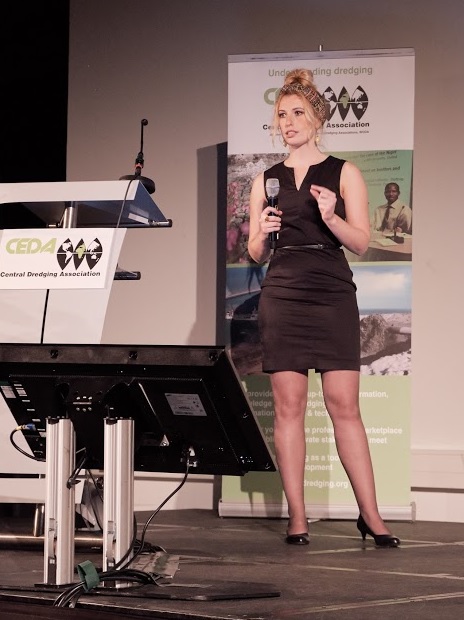
Camille Kapela at the CEDA Dredging Days 2017 (Credit: CEDA)

Another I would recommend is the presentation of my colleague Frank de Hoogh about the new MAD gravel hopper dredge6. It is not just another boat, it is a change of concept. And there are so many interesting innovations on this dredge, that it merits its own sneak preview.

Innovative Marine Aggregate Dredge for gravel dredging

But there are more interesting perspectives on the event. In contrast to other commercial conferences on dredging, this is like a gathering of a community. It is a place for all the commissions and working groups within CEDA to present their efforts and show the reports and results of their work. There is a presentation of the Working Group on contract selection7, an update from of the Working Group on soil investigation and an interactive session themed on the recently published book: ‘Dredging for Sustainable Infrastructure’8.

The interactive session at the previous CEDA Dredging Days (Credit: CEDA)

Above all, it is a social event. All the knowledge presented would be worthless, when there is no community that absorbs the produced information. Would discuss about the content, the feasibility and possible applications. And these discussions generate innovative ideas on the new insights from the presentations and meetings.

Sometimes, I am asked: ‘What good is it to be a CEDA member myself? I can get the benefits of the presentations, the reduced price and the drinks, through the membership of my company. Why would I throw out my personal money?’ Well, it is not about all that. It really is about people and building a community. Having a (small) personal investment brings you in the state of mind, that you belong to this wonderful community with its long history in shaping the world. And that is the real benefit of being an individual CEDA member9. With this personal contribution you can take part of shaping the future of the world.

Thursday evening is the big get together of the dredging community; meet you there! (Credit: CEDA)

References

  1. Countdown to the CEDA Dredging Days 2017, Discover Dredging
  2. CEDA Dredging Days 2019, CEDA
  3. Committees, CEDA
  4. Dredging in Monaco: challenges and solutions, CEDA
  5. CEDA DMC Visits the Anse du Portier Project in Monaco
  6. Next generation marine aggregate dredger as platform for innovation and basis for fleet renewal, CEDA
  7. Effective contract selection: CEDA’s guide to optimised contracting methods, CEDA
  8. Interactive session, CEDA
  9. Why join CEDA?, CEDA

See also

Don’t Play Games With Your Wear Part Planning

Board game for wear part manufacturing planning

Last week we had another of our training courses for service engineers and field service engineers1. The interaction with people actually working with our products is quite refreshing and every time I understand their issues better. One of those issues is that they have to discuss with the client are spares for the wear parts. In a planned maintenance context, wear parts are a little odd. Sometimes, they are worn away or break down unexpectedly. And that is the moment customers call for spares. We do have a lot of spares on stock, but sometimes even we run out of stock or we advise to use a special execution of the concerned part for the specific operation of the client. And then we have to inform the service people and the client that there is a long lead time. Several times, they are filled with disbelief and under such circumstances it is very difficult to explain the reasons behind it. So, that is why I developed this little game to experience the waiting time for special wear parts.

Layout of the board for the wear part game
Layout of the board for the wear part game (Download pdf version here)

It is based on the old board game of ‘Snakes and Ladders’2. All it takes are the board, one dice and as much tokens as players. All start at the first position. The places are all phases in the manufacturing of the wear parts and each have their specific issues.

  1. Each pattern is used multiple times and wears down, itself. Also, some patterns have to be configured for the specific application, execution or material of the wear part.
  2. Moulding: the pattern is placed in a casting box and filled with sand.
  3. Sometimes there are more casting boxes needed and they have to be stacked carefully. Depending on the configuration, this step might be very short. Then you go directly from 2 to 4.
  4. Part of the casting system is already in the sand box with the pattern, but it has to be finished as the last part of the preparation.
  5. The material is melted in the furnace. This can take some time, depending on the size of the cast.
  6. The actual casting is done in minutes. Fifteen, at the most.
  7. But the cooling in the casting box takes weeks. Wait one turn.
  8. Sometimes the casting has not gone properly and the cast have to be done again. Back to square one.
  9. Satisfied with the cast, then it has to be touched up at the fettling station.
  10. A special heat treatment brings the final hardness and toughness to the product.
  11. The fitting surfaces of the wear parts have to be machined.
  12. Rotating parts have to be balanced. For non-rotating parts, this can be skipped.
  13. Then there is the bottle neck: quality control. If there is a deviation that can n ot be mitigated, you have to go back to square one.
  14. Depending on the location, transport can take weeks.
  15. Don’t start me about customs handling. Your anticipated spares are in bonded storage and customs is missing a document, wait some weeks or skip a turn.
  16. Finally, you’ve made it! Installation on the dredge.

Message of the game: keep your warehouse well stocked with wear parts3,4, or your dredge will be idle for months, before you can work again. Have fun!

Spare parts on stock

References

  1. A well-trained team makes all the difference, Damen
  2. Snakes and Ladders, Wikipedia
  3. Do You Have Wear Parts For Spare?, Discover Dredging
  4. Options for Repairing Parts That Ought to be Replaced, Discover Dredging

See also

Deposition Of Dredged Material At Reclamation Areas In Ancient Chinese And Modern Times

Hills of Jingshan Park Beijing

As promised, I still have several stories for you and this is another one. As you may remember, we’ve visited China for attending the WODCON in Shanghai1 and afterwards travelled to Beijing for sightseeing. A must see destination in Beijing is the Forbidden City. The epicentre of ancient Chinese power, the seat of the emperor. Once the exclusive domain of the supreme ruler, now a tourist attraction for the general public. The Forbidden City was mainly build in the Yongle era of the Ming dynasty2 between 1407 and 1420. It comprises numerous courtyards and halls and temples. All the buildings are surrounded by thick walls and a moat.

Moat around the Forbidden City

This moat is an impressive 6 meters deep and 52 meters wide. That is a big moat. But remember it is long: 3.5km around3. So, it is an impressive moat. Now consider this moat is dug in the fifteenth century. It has been dug by hand! Imagine, thousands of labourers digging, carrying and removing the soil from the moat. That is quite an operation.

To put this in perspective. The moat has a volume of 6x52x3,532m=1,101,984m³. Yes, that is over a million cubic meters. Even for a modern dredging project it is a serious volume. And digging a hole at one place is the first step. Where do you dispose it? At a dredging project, there is a reclamation area. As this was dry land, there was no reclamation area. So, what do you do with such a volume? If you pile it up, you can store a volume of V=1/3 pi r² h in a cone. Assume a slope of one third of the height to the radius, the height of the pile can be calculated and will be around 49 meter. And that is exactly what the ancient engineers did: they created the hill of Jingshan Park4. With its five peaks, it is not exactly a cone, but the estimated height was quite close!

Height marker at the top of the hill in Jingshan Park

The engineers had probably carefully planned how they constructed this hill and planned the delivery of the material accordingly. Nowadays, with the much higher production rates and shorter project delivery times, it is highly inadvisable to build a reclamation area with this height. There are several reasons why not to do it like that. First, it would take time to drain the pore water away from the core of the hill. Loading more on top quickly would make it very instable. Sometimes with disastrous results5. Another is when you create high banks, it will be easier for shear planes to form and collapse the structure that way. Lastly, a lower reclamation area will also have a larger surface area and more choice to select multiple locations to evenly distribute the material in volume and composition. A well designed reclamation area requires good knowledge of the deposited material and a skillful team that operates the equipment to manage the deposition.

Explanations of issues with depositing sand at reclamation areas

Based on the exposed rocks sometimes seen on the sides of the Jingshang Park hill, the core is probably consisting of bigger rocks as a kind of backbone. But not every rock found in the moat ended up in the hill throughout the area. Several decorative rocks can be found that have a typical size that could just be handled by manual labour. Just another tribute to the perseverance of those classic engineers.

Decorative stone in Bei Hai Park west of Jingshan Park

References

  1. WODCON XXII, EADA
  2. Yongle Emperor, Wikipedia
  3. Forbidden City, Wikipedia
  4. Jingshan Park, Wikipedia
  5. Aberfan disaster, Wikipedia

See also