Experiencing The Cutting Edge Of Dredging Technology

Exhibit on cutting forces at the Damen Dredging Experience

Ever tried to eat peas with a knife? Didn’t fare well, right? Sorry, this post will not help you. It is just more entertaining doing so. And you might remember this week’s lesson.

After all the other posts, I would like to continue our tour along the exhibits of the Damen Dredging Experience. We’ve seen at “the Bank” that by gravity and hydraulic action the sand can start moving towards the suction mouth. Another well-known mechanism for collecting the sand is by cutting. This mechanism is primarily used in the cutter heads of CSD’s of course, but also in the trailing drag heads of TSHD’s.

Be aware, that the gravel sample in the exhibit is an artificial sediment, specifically designed to be porous and demonstrate the “rolling peas effect”. Naturally occurring gravel sediments have a wide range Particle Size Distribution and will have virtually no gaps between the grains. The smaller grains will lock the bigger grains in place and it will be more difficult to move them.

In this exhibit you will see two different types of sediment. Wet fine grained sand and very coarse gravel in a jar with a handle. When you rotate the blade in the gravel, you will notice a rather high cutting force, that remains relatively constant. The water can easily move through the pores. Rotating the blade in the jar with sand, is very hard at first. But as soon, as there is a chunk of sand dislodged, the cutting force is decreased dramatically. The decrease can be explained by the fact, that once water has entered the shear plane, it cannot dissipate back in the pores and will lubricate the chunk moving over the bed. This is a phenomenon, sometimes encountered with ploughs.

Under pressure in densely packed sediments

The theory of cutting sand is largely explored by dr. S.A. Miedema1. He wrote an extensive book2 on this subject and anyone interested in the details is encouraged to read it. Again, the basis for cutting sand is the dilatancy of sand, just like in the previous exhibit. The grains are moved and the water has to be forced in the pores. As the blade moves at a certain speed, the sand exerts a horizontal cutting force on the blade. Force, times speed is power. At this speed and cutting height you have a certain production. Power divided by production yields a Specific Cutting Energy3, which is a parameter for how much effort it costs to cut 1m³. The SCE is largely governed by the undrained shear strength and the angle of internal friction and is different for every type of sediment. They are measured with a Cone Penetration Test4,5. In order to estimate the production of the dredge, we really need to know these parameters. If they are not available, maybe you can receive the results from a Standard Penetration Test6,7.

Basic explanation of the theory of sand cutting

From the equations, you can derive that for a hard material, the SCE can be quite high. Consequently, with a known installed cutter power, the production Q will result quite low. From this perspective, there is no upper limit in the hardness of the soil, anything can be cut. It is just, that the resulting production might be too low for a viable business case. In this respect, it is always difficult to say the maximum hardness of the soil the CSD can cut. Usually, the increased vibrations and unsteady process will limit the productivity in such circumstances.

Example of a cutter production for a CSD

This provokes a nice practical experiment for you at home or when you have you have to entertain guests at dinner: have a nice recipe with big peas and fine grained rice8. Serve the peas and rice separately and notice the variation of effort to stir the ingredients separately. Then, mix a portion together and notice the increase in cutting force. For enhanced realism, add some sauce. Exclaim your amazement to your perplexed table partners and explain that you are not playing with your food, but are on a study assignment for your work. Bon Appetit!

Ingredients for a pea and rice recipe

References

  1. dr. S.A. Miedema, TU Delft
  2. The Delft Sand, Clay & Rock Cutting Model, Dredging Engineering
  3. CEDA Webinar Specific Cutting Energy, CEDA
  4. Cone penetration test, Wikipedia
  5. Painted Hills, how to unveil the sediment layers below the surface, Discover Dredging
  6. Standard penetration test, Wikipedia
  7. Lessons in Camping: Basic Soil Investigation, Discover Dredging
  8. Nice rice-a-pea, Albert Heijn

See also

We Choose To Adopt Energy Transition, But How Will We Succeed?

President John F. Kennedy speaking at Rice University on September 12, 1962 (Credit: NASA)

‘We choose to go to the moon.’ Was the famous speech at Rice University of President John F. Kennedy to express his ambition to send his nation to the Moon1. At the time, his call was far from clearly achievable. But it was a very clear roadmap and it quickly gained traction. The success of the Apollo project is well known. Neil Armstrong did land on the Moon within a decade and the American flag is still planted on its surface.

Panel discussion at the CEDA Dredging Days 2019 with Mike van der Vijver

At the CEDA Dredging Days 20192, there was an interesting panel discussion on ‘Energy transition: the views in our dredging community’3. Panel members were: Eric de Deckere, Michael Deruyk, Kaj Portin and Klaas Visser. The discussion was moderated by Mike van der Vijver from MindMeeting. As an introductory teaser to the audience, he posited the claim: ‘Excessive ambition drives breakthroughs’. The question is: ‘Is the dredging industry ambitious enough to convert to a new fossil free energy source?’ The audience was polled for their opinion on a scale from one to ten and the response ranged from three to eight. The three represented the position, that the industry is not doing much. What is visibly done, are only single purpose, company specific solutions that are not adopted by the community. On the other hand, there was also a very positive signal with an eight for ambition. The sense of urgency is very well present in the community. Most companies are developing plans and cooperating in working groups, such as the CEDA Working Group on Energy Efficiency4. Also, the government is pitching in with initiatives on zero emission maintenance dredging, where the dredging community is actively participating in putting forward proposals.

So, why is there still no zero emission dredge? What is the ambition lacking? The hint is the opinion that the effort is not focussed. The strong motivation in Kennedy’s speech was that there was a very clear picture what to do. What do we do: ‘Put a man on the Moon’. When: ‘By the end of the decade’. How: ‘Bring him safely back’. Ambition with a clear plan can indeed achieve great things. Ambition without motivation will only bring daydreaming and lethargy.

Block diagram of influencers for energy transition in the dredging community

To achieve something, we need motivation. And who is responsible for pulling this off? Mike polled the audience again for: 1) Government, 2) Public opinion, 3) Companies, 4) Technology. There was not a clear picture here either. All positions are valid. Another driver is the reward for the effort. The Apollo project effectively created part of our modern society. What would the energy transition yield for the dredging community: ‘Learning by challenge’, ‘Flexibility and resilience in energy generation’, ‘Low maintenance and higher independence’?

At this website I can’t change the world, but addressing most issues mentioned, I can only put forward my idea on the ‘How’ motivation. We know how to apply power. As long as the power arrives electrically, we can use it. Essentially, we have to generate electricity with a flexible power source. The investment lifetime of a dredge often exceeds 30 years, but under the current circumstances, the power plant only lasts ten. The solution would be to have some separate module for power generation. Either locally, near the dredge, or remote at the end of the pipeline. As every project and application will be different, it will be a challenge to design the specific solution. But I am looking forward in developing the solutions below with any interested customer5.

Transition schedule to convert to fossil fuel free dredging equipment

References

  1. We choose to go to the Moon, Wikipedia
  2. CEDA Dredging Days 2019, CEDA
  3. Programme 7 November 2019, Panel Discussion, CEDA
  4. CEDA Working Group on Energy Efficiency, CEDA
  5. Innovation at Damen Dredging Equipment, Damen

See also

Innovations In The New MAD Series To Increase Uptime And Reduce Fuel Consumption

Innovative Marine Aggregate Dredge for gravel dredging

This week, there will be a lot of interesting presentations at the CEDA Dredging Days 2019 in Rotterdam1. I would like to draw your attention to one particular presentation that I was involved with at certain moments in the project, though not in writing the paper. Kudos to my colleagues Frank & Frank to write the interesting manuscript2.

The topic of the presentation will be the change of perspective for the concept of marine aggregate dredging. Historically, the marine aggregate dredging takes place relatively close to shore. With the depletion of the deposits and the increase in demand, other locations further out at sea are coming into focus. As Damen, with a heritage in the design of offshore operating vessels, it was a natural choice to cross breed the offshore supply vessels with the marine aggregate dredges. The resulting offspring: the MAD series of hopper dredges3. Frank de Hoogh will elaborate on the seakeeping abilities of this innovative design.

Other dredging related innovations are the suction tube and ancillary equipment, the screening towers and the process sensors. Of those, I have some personal anecdotes on the screening towers and the density sensor. For all other interesting stories, you’ll have to attend the presentation.

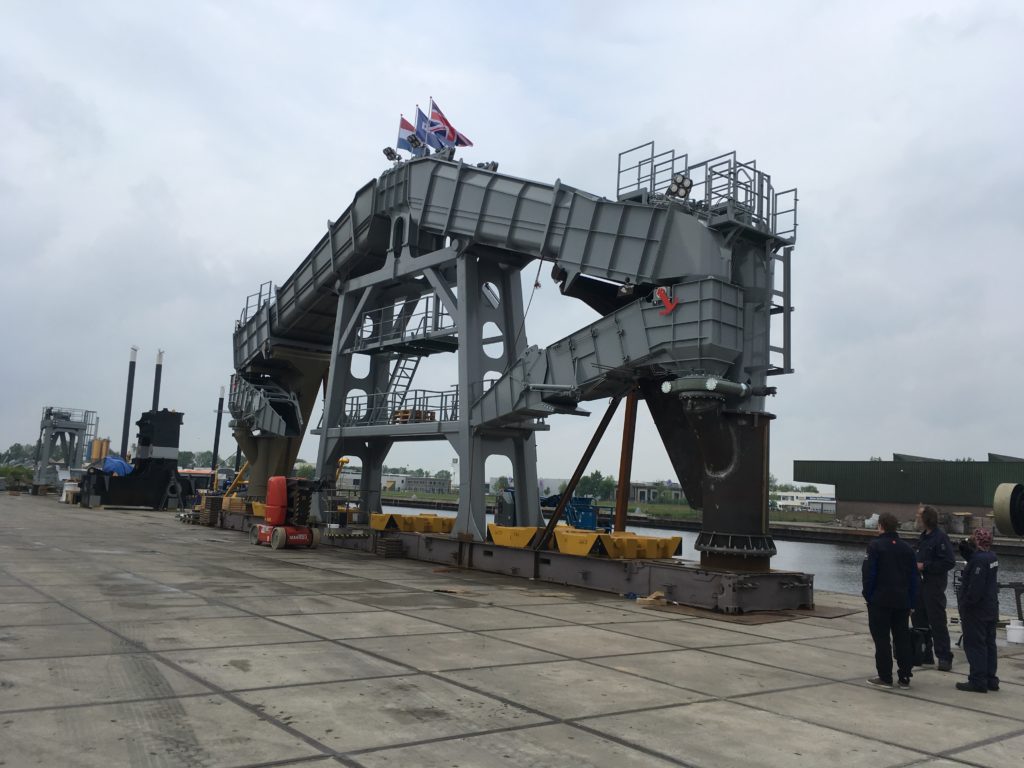
The screening towers are fundamental to the efficiency of the process. If the screening is improved, shorter dredge cycles are possible and a better product can be landed onshore. Also, if the requirement for the product change, the screens have to be adapted to the new specifications. Ideally, this changing has to be done at one unloading phase, otherwise you miss a complete dredge cycle. A lot of effort has been done to optimise the design. But the real test was to actually build, modify and test the complete screening tower, before it was even installed on the vessel. So, we had this construction right here at our doorstep for a thorough evaluation.

Screening towers for fit and fat testing at our yard

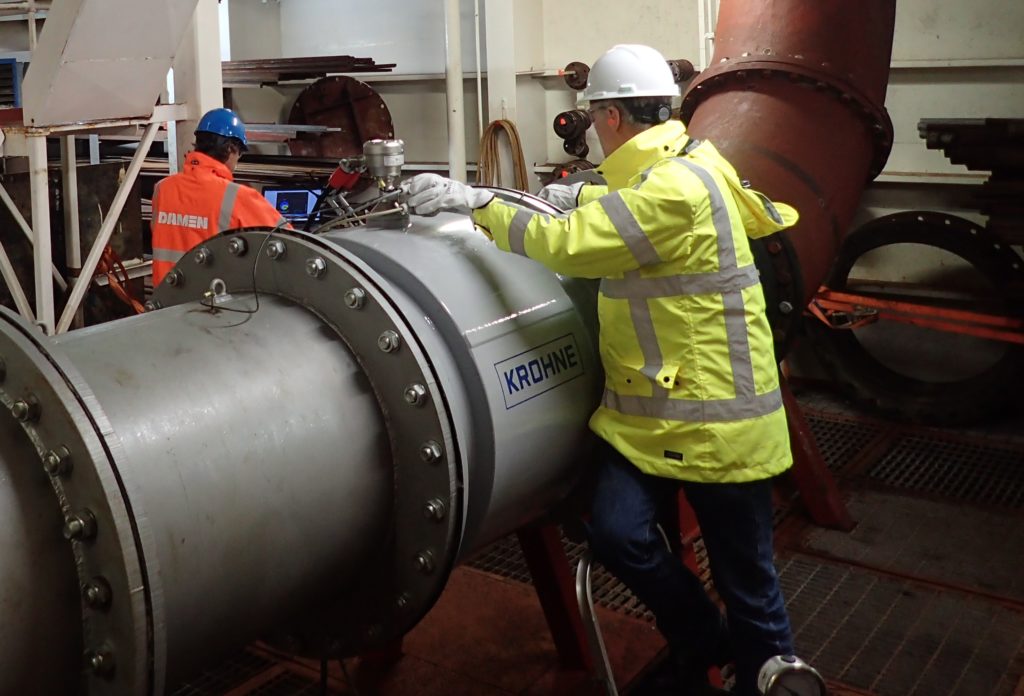
One other component, that I was even more involved with, was the non-radioactive density sensor. There are regulations in place to phase out nuclear density sensors4 and a lot of alternatives are available. Back in the !VAMOS! project5, we had the opportunity to test a unit of an electro tomography system. The results indicated a good reliability and a worthy replacement for the traditional nuclear sensor6. Because of the tomography picture, there was an additional benefit: we received an early warning on the slurry behaviour. We could actually see when we were too close to the deposition limit in the pipe line. This enabled us to work with higher densities at lower velocities, resulting in better efficiency and less wear. As the rough process conditions in the mining pit were similar to the marine aggregate dredging industry, we proposed to use this on this MAD also. How we further developed and tested this system is for you to hear and see at the presentation.

Testing the non-radioactive density sensor

Due to the physical processes involved in slurry transport, the mixture does not behave like a normal Newtonian fluid. It is some non-linear viscous substance. At high speeds and low concentrations, it is similar to the carrier water. Slowing down, there is a certain critical speed, where there is a minimum hydraulic gradient. At that flow condition, the specific power consumption of moving a cubic meter of soil is the lowest. So, although working at critical speed is dangerous, it has its advantages: low fuel consumption and less wear. Actually seeing the mixture approaching this critical speed from the deposition is an interesting feature of this new density measuring sensor.

Explanation on slurry flow conditions, critical speed and specific power consumption

References

  1. CEDA Dredging Days 2019, CEDA
  2. Next generation marine aggregate dredger as platform for innovation and basis for fleet renewal, CEDA
  3. Damen unveils Marine Aggregate Dredger, Damen
  4. Regeling bekendmaking rechtvaardiging gebruik van ioniserende straling, Staatscourant
  5. Project ¡VAMOS! Let’s Go Real!
  6. Real time production efficiency based on combination of non-nuclear density and magnetic flow instrumentation, WEDA

See also