Young CEDA Evening: the Grabbing History of Dredging

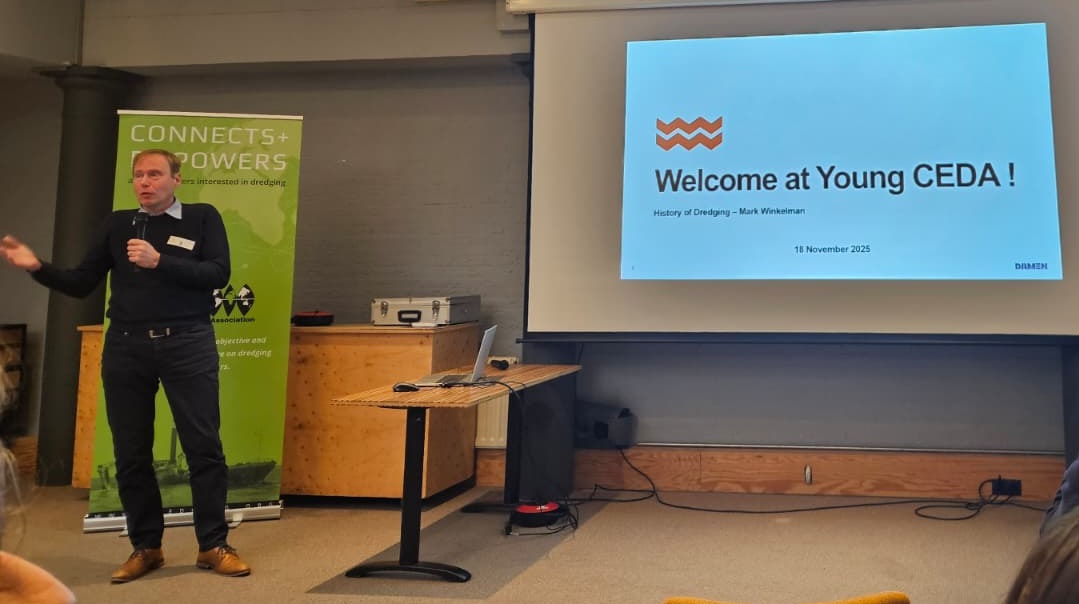
Presenting my lecture on the history of dredging at Young CEDA

Last Tuesday, I gave a presentation for Young CEDA1. The topic was to be about the history of dredging2. And I happily accepted the invitation to educate the younger generation into the tradition of our craft. I consider myself somewhere in between. Not part of the old generation, but past the younger generation. Though I am old enough to have heard the old guys talk about their history and their knowledge of where our modern industry came from. In particular those stories came from the lectures by professor Jan de Koning3 I attended as a student. He really was able to put a perspective on the origins of processes and technologies. Some of those stories have been recounted on my website already4. The oldest dredging project5, the oldest rock cutting technology6 and the oldest dredge canal7 still in use. They were all there at the presentation that evening.
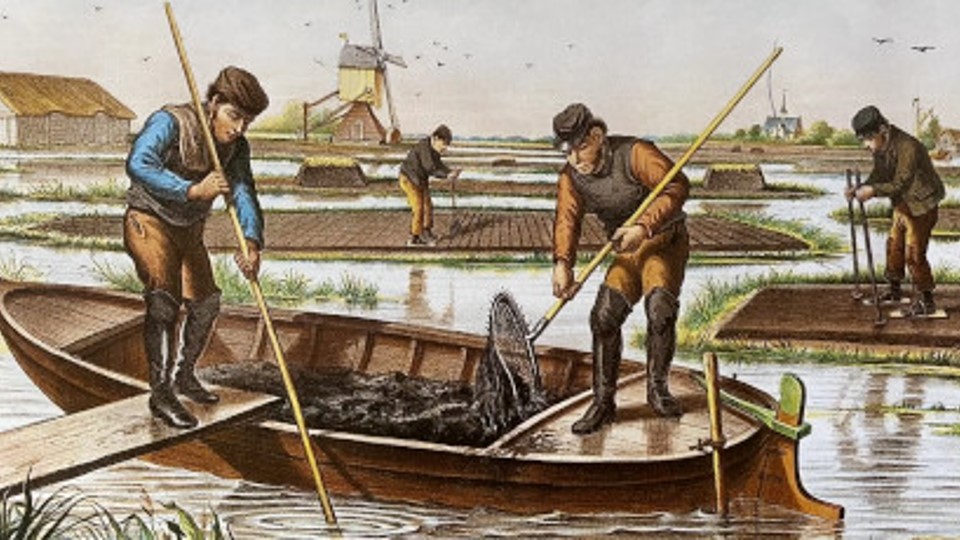
Traditional dredge scoops for peat dredging and waterway maintenance (Credit: Wikipedia)

Here I would like to focus on another development presented that evening, but new on my website. A well known tool in the industry was the dredge scoop8. It has been used for ages, until even recently. However, the working depth is limited to the length of the stick. Longer would make it hard and impractical to use efficiently. In ancient Persia, there were three Banū Mūsā brothers9. Three scholars in 9th century Baghdad, who worked on astronomy, mathematics and engineering. Ahmad Banū Mūsā published ‘The Book of Ingenious Devices’10 which described a tool to pick things up from underwater, specifically oysters.
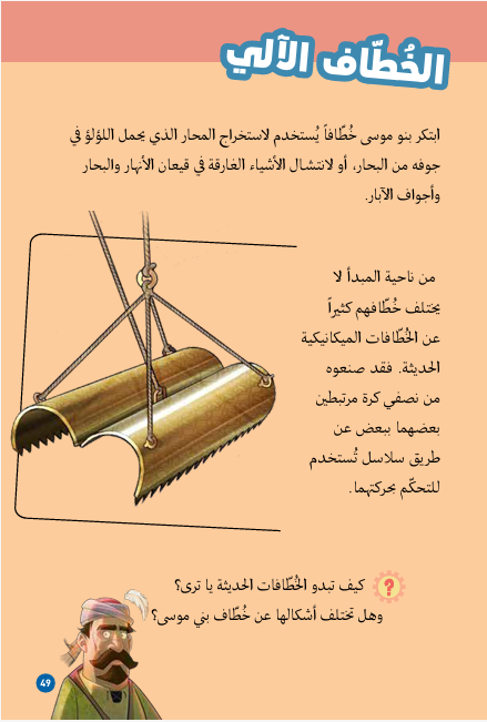
Oyster grab invented by Ahmed Banu Musa (Credit: 1001 Inventions)

Ahmed Banū Mūsā described in detail the phases in the cycle: lowering, closing, lifting and opening. And it already looks very familiar to the grabs we are using today in the dredging industry known as a clam shell grab. Modern versions are constructed from steel and hydraulically operated. The capacity is usually a couple of cubic meters. But there are designs of up to 200 cubic meters11. The advantage of grab cranes is their simplicity and employability. Whether sand, clay or rock, special versions can adapt a crane to the requirements of your project. The disadvantage is that they can be messy and it is a discontinuous process. Usually involving multiple barges, making them labour intensive. Still, with the right experience and man power, this is the tool of choice for many countries.
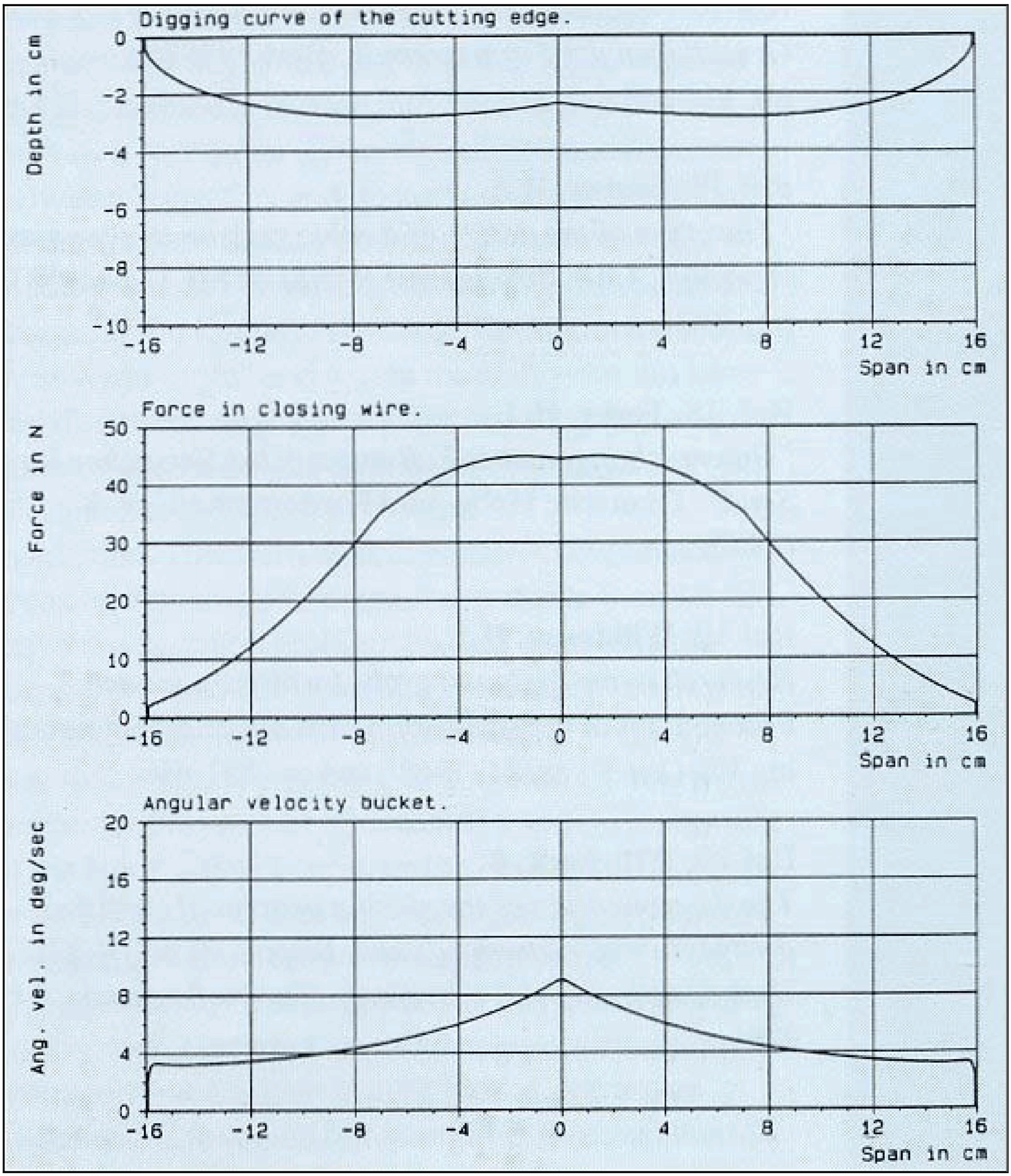
Closing process of a clam shell grab under water (Credit: Sape Miedema)

One of the most important phases is the closing process of the clam shell grab. Here are the limitations on the power and operating speed, that are the most important in the calculation of the cycle time and equipment capacity. Sape Miedema has proposed a model for this phase in the grab cycle12. The rest of the cycle is just adding up the operating times and multiplying by your number of cycles.
Sometimes the grab crane is placed on the barge itself to reduce the total investment and running costs. When looking for such a vessel, it can also be interesting to consider adding a trailing suction pipe or a DOP pump to make the vessel even more adaptable to the project requirements.
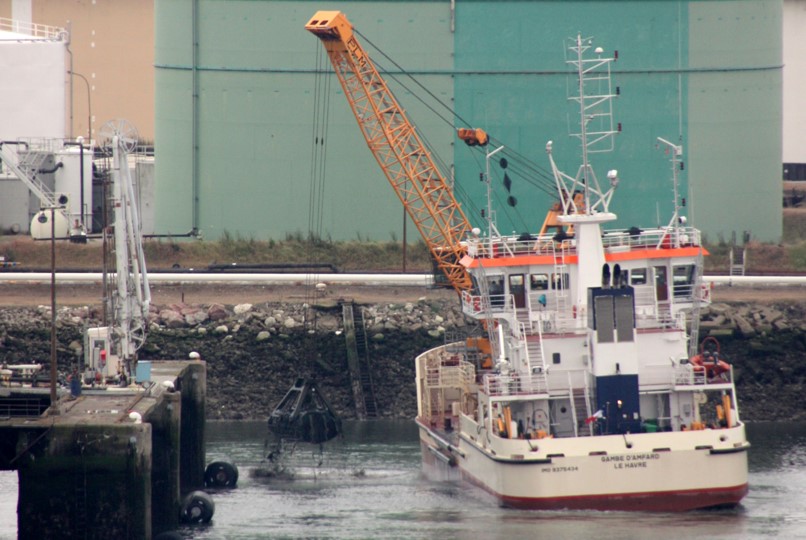
Damen clam shell grab crane hopper with a trailing suction pipe

References

  1. Young CEDA, CEDA
  2. Young CEDA, CEDA-BE & CEDA-NL Event, CEDA
  3. Tag: De Koning, Discover Dredging
  4. Category: History, Discover Dredging
  5. The Ancient History of the Cutter Suction Dredge ‘10th of Ramadan’, Discover Dredging
  6. Graduation Omar Karam: Rock Cutting The Egyptian Way, Discover Dredging
  7. Historical Origins Exhibition at the WODCON: the Beijing-Hangzhou Grand Canal, Discover Dredging
  8. Paying Tribute to the Hard Life of Peat Dredgers, Discover Dredging
  9. Banū Mūsā brothers, Wikipedia
  10. Book of Ingenious Devices, Wikipedia
  11. Tosho, DredgePoint
  12. The Closing Process of Clamshell Dredges in Water-Saturated Sand, WODCON
See also

Increase Your Dredging Knowledge At The End Of The Discharge Line

Keeping watch at the end of the discharge pipe line

Solving something at the end of the pipe is usually a less desired approach. However, in dredging, it is the place where the valuable stuff is delivered, it might be a good place to start monitoring your process. Let me explain this to you by going back to latest discussed exhibit at the Damen Dredging Experience1.

Pump power exhibit at the Damen Dredging Experience

You might have observed in the pictures of the pump power exhibit, that the velocity of the water flow is indicated by the parabolas of the trajectory. The arc of water is bound by gravity and obeys this trajectory always; independent of the density of the mixture. The two equations of motion can be combined, where the time parameter falls away and the height for a certain distance is only depending on the initial horizontal velocity2. As such, it is fairly accurate indication of the pipe flow. The calculation is universally applicable on earth and the results can be presented in a very simple graph to take with you. Every parabola is labelled with the corresponding horizontal velocity.

Nomogram to find end of pipe velocity

The above example is a straightforward method to measure the mixture velocity. The US Geological Survey even extended this approach as a standard method to measure the production of wells3. The resulting nomogram has a slightly different layout, as it is intended for finding the production instead of the velocity. For production planning, this will be useful. For monitoring your dredging process, the velocity might be more important. Both approaches of this elegant method do have the benefit, that there is no obstruction needed as in the case of an orifice measurement4.

Nomogram to find the end of pipe production

There is an unconfirmed anecdote that my old professor de Koning started his career as a velocity measurer. In the old days, when he was working as a twelve year old boy with the dredging company of his father. He was assigned to keep watch at the end of the pipe and monitor the mixture pouring out. He had a simple beam with a plumb bob. The beam was moved along the top of the pipe, until the plumb bob was touching the arc of mixture. On the beam were two markings. When the beam was moved in and passed the first mark, the mixture velocity was too low and a red warning flag had to be displayed. If the beam had to move out and the mixture velocity was too high at the second mark, a green flag had to be flown. There was also another white flag, in case only water came on the reclamation area. With this very simple setup, the dredge master could check through his binoculars what the state of the dredging process was.

Working principle and explanation of end of pipe meter

They were clever in those days. But the physics still apply. So, even today, one might have a situation, where there is no electronic velocity measurement available (broken, not supplied, not (yet) purchased) and you have to push the limits of the operating envelope of the dredging process. Then, there is probably always somebody around that might be appointed volunteer to be head of the velocity measurement crew. Who knows, he might have a bright future in the dredging academia.

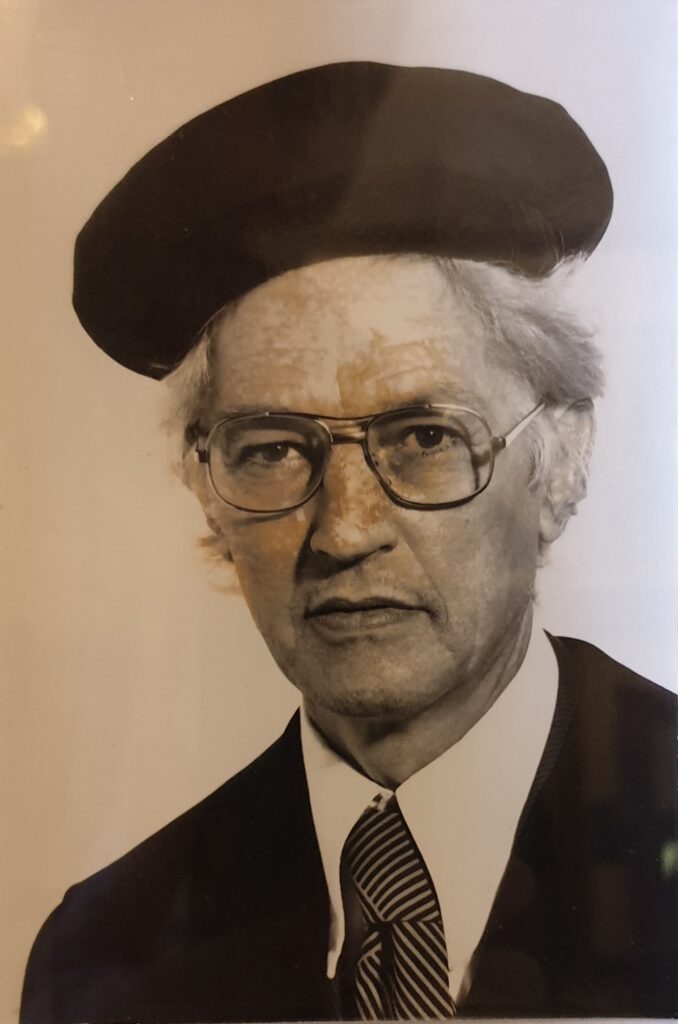
Professor de Koning of the dredging chair at the TU Delft (1981-1993)

References

  1. Presenting Pump Power Peculiarities, Playing With Pumps And Pipes, Discover Dredging
  2. Projectile motion, Wikipedia
  3. Estimating discharge from a pumped well by use of the trajectory free-fall or jet-flow method, US Geological Survey
  4. ISO 5167 Measurement of fluid flow by means of pressure differential devices inserted in circular cross-section conduits running full, ISO

See also

Graduation Omar Karam: Rock Cutting The Egyptian Way

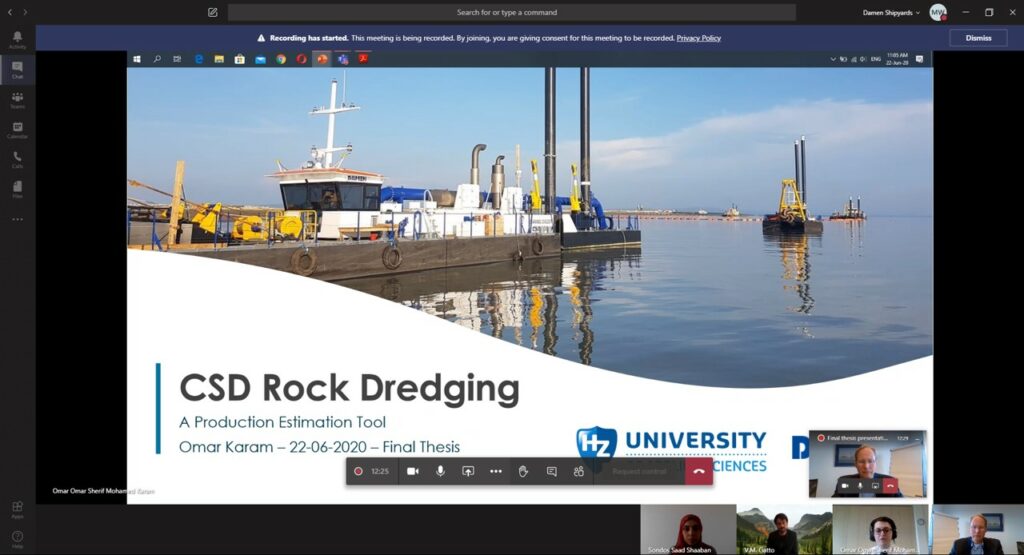
Graduation presentation of Omar Karam

Egypt is a great nation when it comes to ancient engineering. No other country has such a concentration of impressive monuments and such an interesting history as over there. If you are not convinced that modern Egyptians are not capable of great engineering feats you are wrong. Last Monday, Omar Karam graduated at our R&D department of Damen Dredging Equipment1 on his thesis about ‘CSD Rock Cutting.’

Cutting processes have been extensively described by Sape Miedema in ‘The Delft Sand, Clay & Rock Cutting Model’2. Omar has been using the frame work of Miedema to make some useful tools for the estimation of the production of our dredging equipment in rock. In due time, you will find the results of his thesis in the online dredge selection tool ‘Sandy’. Omar’s curiosity and ingenuity does not end here. He will continue studying at a university, but I do hope to meet him again, as he would be a valuable asset for our dredging community. Keep an eye out for him.

Program structure diagram of cutting force calculations

His graduation brings me back to my first lessons in dredging technology at the Delft University of Technology by the illustrious professor de Koning. In a sense he was an old school engineer, who hammered it in to us that thinking is done by doing it with your hands3. Back than the Polytechnic School was just rebranded to University and he was mocking that as a university, we had to set the topics in a broader perspective. So, he started his introduction on cutting technology with some slides of the unfinished obelisk at Aswan4 as every aspect of the cutting process could be illustrated.

Phases of chip forming in rock cutting

The story according to de Koning is: ‘Around the quarry of the obelisk, they have found diorites5. These are some sort of volcanic balls of rock. In combination with the marks and scratches all around the obelisk, archaeologists believe these stones have been used to pound the granite. The impact compresses the bedrock and the resulting stresses fracture the contact surface(1). For every hit a whiff of dust is created. Eventually the dust is collected and scooped away for the next layer. Next, trees would be planted in the trench on one side of the obelisk. The growing root system displaces volume and create shear stress underneath the obelisk that would sever the obelisk from the bed rock(2). At last the trees are removed and dry wooden dowels would have been inserted in the shear cracks. Saturating the wooden dowels will make them grow. The last strands of rock will now be broken due to tensile stresses(3). Repeated insertion of new dry dowels and saturating them will lift the whole obelisk enough to pull some ropes under and carry the obelisk away to the building site.’

Although the diorites and the scratch marks are a smoking gun, current archaeologists argue about the feasibility of this process as experiments yield a very low production and it is doubted that the obelisk could be finished in the lifetime of the client6. Even if disputed, de Koning told a story that conveys the message; I vividly remember it and makes me understand the rock cutting process.

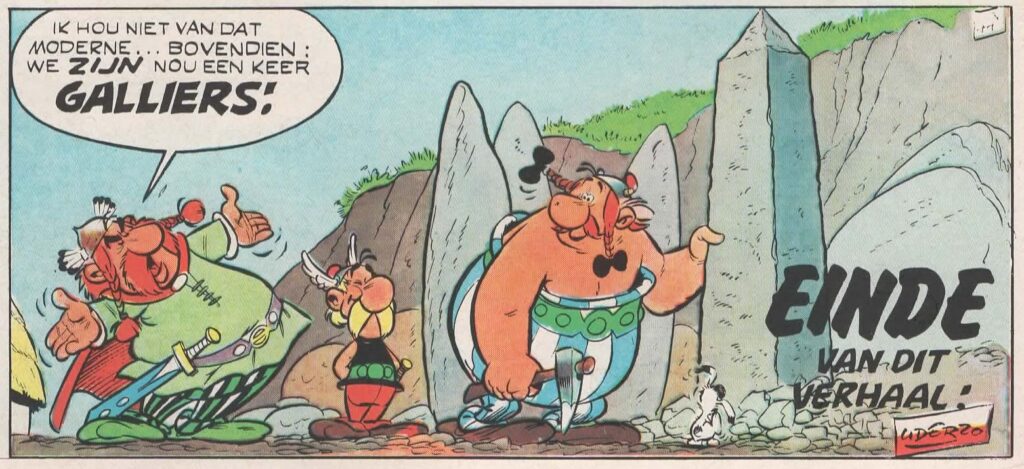
These mysterious monolithic ornamental spires have been an inspiration for many legends and stories. When we have solved the riddle of the rock cutting with diorite balls, it may inspire the development of new rock cutting technology for the dredging community and we can put the story of the obelisks to an end.7

End of the story on the cutting of obelisks (Credit: Uderzo)

References

  1. Innovation, Damen
  2. The Delft Sand, Clay & Rock Cutting Model, TU Delft
  3. De Koning (1978), Denken met de handen’, TU Delft
  4. Unfinished obelisk, Wikipedia
  5. Diorite, Wikipedia
  6. The Unfinished Obelisk, NOVA
  7. Asterix and Cleopatra, Goscinny-Uderzo

See also