The Last Dredging And Port Construction Magazine, The End Of An Era

The last issue of Dredging and Port Construction

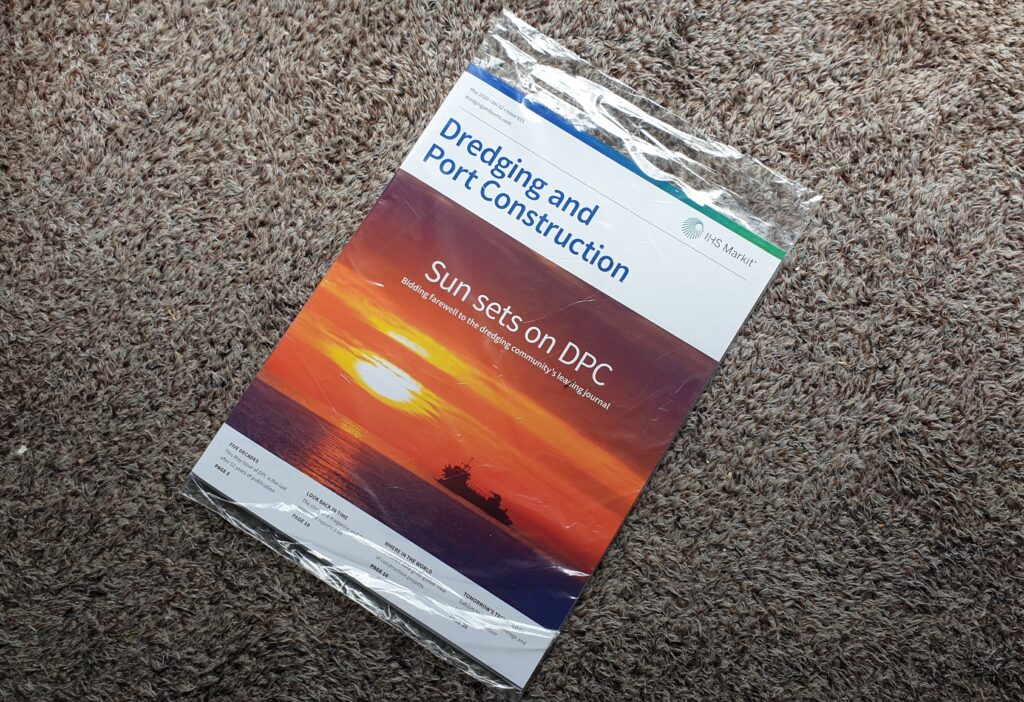
It is not very often that one experiences the end of an era. Hiroshima, the fall of the Berlin Wall, Brexit. Those were very important events with a global impact. Now there is another end of a period, with only a limited impact on a small community affected. After half a century, our trusted journal ‘Dredging and Port Construction’ has come to an end1. In the fast moving media world, this will only be a footnote in history. Yet, as a magazine, it was close to our community. It reported on projects and people we knew, but also as a platform for the CEDA to communicate with us for 42 years2.

IHS Markit has decided to cease this publication, the lack of new subscriptions and decreasing advertisements. You know, the general malaise in paper printing. Somehow, the digital revolution didn’t turn out so well for them. Other digital media providers covering the dredging industry seem to have a better business model to survive the transition. Right?

Well, there is a big disadvantage of those free service, hot shot, social media savvy new comers, they just forward press releases that they receive or sweep up from social media. They don’t have dredging literate expert editors writing long genuine articles about topics that would not have access to coverage by themselves. Having your own knowledgeable editors doing original research vetting the facts and reporting from a broad perspective with a solidly founded opinion is expensive. And that makes it very difficult for a classic publisher to survive in these modern times.

We will suffer in this new era without our trusted DPC. We can sign up to the usual free subscription daily newsletters from the new media publishers and read the endlessly repeating press releases. We will miss the in depth reports on big projects or critical comments on regulatory issues. We will have to figure this out from within our own social media bubbles. It will narrow our view and I certainly hope we don’t lose the perspective of other members in our community.

Please be advised, that also the website will be closed at the end of June3, leaving only the digital archive of the magazine accessible4, which goes back to May 2015. Although the last editor, Ines Nastali, told me she is happy to send out articles if requested by the dredging community. There will only be some dusty old paper versions that are stored in a forgotten archive or that one issue we keep for some sweet memory. At least that is what I have done. Over the years, I have written several articles that have been placed in this magazine and I cherish those issues. The first one was already long ago about a CEDA excursion to the IJsseloog in the Ketelmeer project. The last one was a reprint from my post5 about energy transition in the dredging industry discussed during the CEDA Dredging Days6.
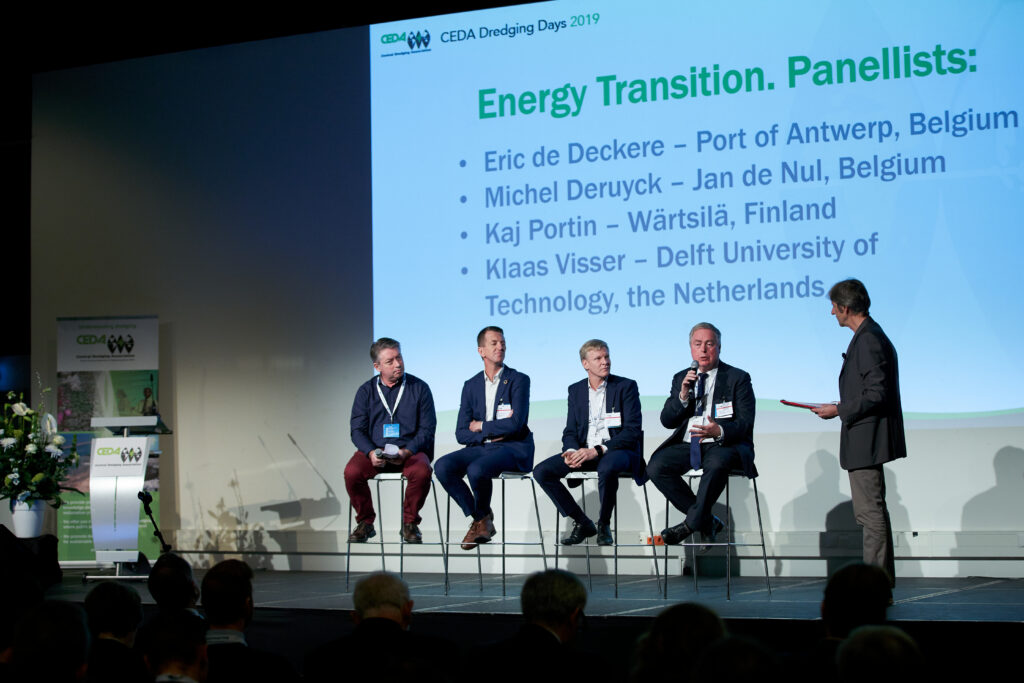
CEDA Dredging Days 2019 panel discussion (Credit: CEDA)

It was a good experience to contribute to the magazine that way. And made me proud, that my posts at this website were picked up by the media. I will see what will come along in the future. I am open to any opportunity. At least, I am determined to keep www.discoverdredging.com alive as an independent platform to point out dredging related topics. And this will be a lonely place left to find an opinion about our community, albeit, very personal.

Although we are an industry in an economic sense, it is a community. When I think of companies and projects, I think about the people I know over there. And my memory about Dredging and Port Construction will not only be the magazine, but also the nice cooperation with the editors. At this moment I would like to especially thank Tony Slinn, Lisa Maher and Ines Nastali for a their work.

Ines Nastali, senior custom publishing editor (Credit: Ines Nastali)

References

  1. End of an era, IHS Markit DPC
  2. IHS DPC Latest, CEDA
  3. About us, IHS Markit DPC
  4. Welcome to your digital magazine portal, IHS Markit
  5. We Choose To Adopt Energy Transition, But How Will We Succeed? Discover Dredging
  6. Dredging industry addresses energy transition challenges, IHS Markit DPC
See also

CEDA

Graduation Of Carsten Markus: Designing And Casting Of Impellers

Impeller under operating load.

Last week, Carsten Markus graduated on his assignment with our research department Damen Dredging Equipment. He investigated the alloys that are used to cast our impellers and the responses of the materials under operating conditions. We are always improving our dredge pumps and Carsten’s work has been a great contribution for our development.

For every dredging application, the material for the dredge pump parts can be carefully selected according the specific requirements on the sediment handled. Off course, one would like to have the hardest, most erosion resistant material available. Less erosion is less wear and a longer lifetime1.

Wear part material hardness in relation to wear index

However, there is a downside to choosing very hard material: it will be very brittle also2. Basically, the ultimate tensile stress coincides with the yield stress. There is no reserve for the load. When the stress surpasses the yield strength, it just snaps. Conversely, a tough material has a lot of reserve. After deformation beyond the yield stress, the load can still increase without a catastrophic failure. Usually, the stresses would not be that high, the thickness of the wear parts is dimensioned for erosion reserves and thick parts have low stresses. The high stresses can come from concentrations. Either when the wear reserves are eroded, or when a heavy load is concentrated on a very small area. Usually stones. Stones are a very common problem in a dredging project. So, next to the hardness of an alloy, also the toughness will be a very important characteristic. And toughness is related to the yield elongation after failure.

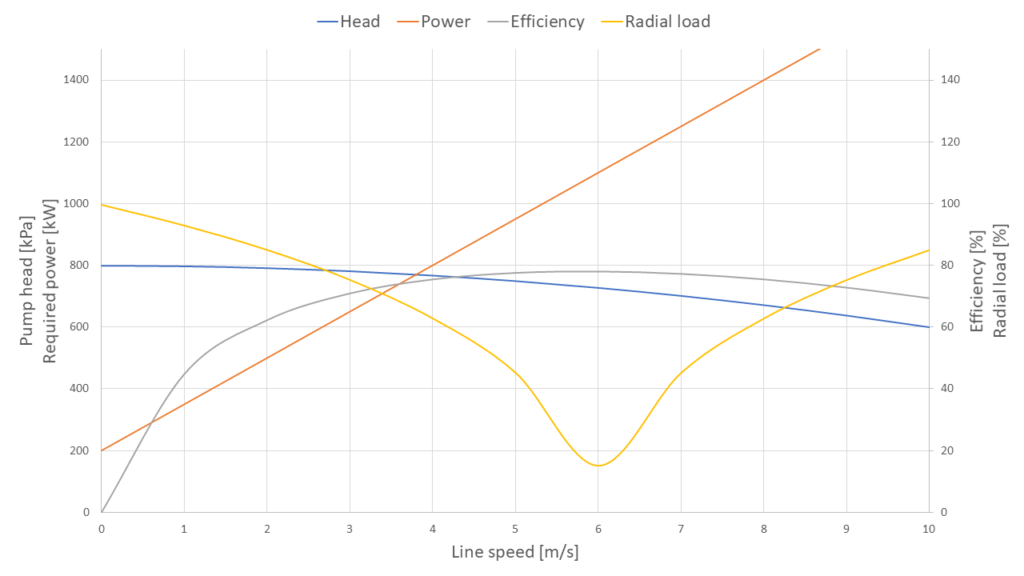
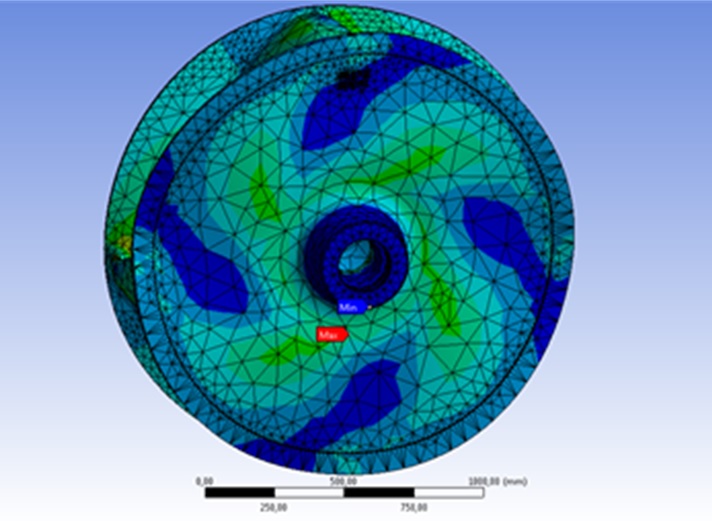
For the various materials you would like to know how the base load relates to the tensile stress. This would be an indication whether there is reserve in the elastic region to accommodate the impact of an occasional stone. This base load depends on many factors in the pumping process. Mainly the pressure generation in the mixture over the blades. Most known literature is about the force distribution in the volute of the pump, as this is directly related to the radial forces and consequently the bearing and shaft calculations. The CFD simulations in this graduation project revealed the skewed load on the volute and consequently the load variations on the impeller.

Transient CFD simulation of a dredge pump. The rotation appears wrong , but is correct (Wagon-wheel effect).

As emphasised before, it is very beneficial to operate your dredge system around the Best Efficiency Point (BEP). Not only the shaft and bearings suffer less, also the impact of the stresses and their variations in the impeller are less. If the operating point differs from the required capacity, the BEP can be moved by changing the dredge pump speed. As long as head requirements permit the adjustment.

Radial load as a function of pump characteristics.

As a result of Carsten’s research, we were able to improve our operating load models for the whole dredge pump and gained insight into the material responses to these. Thank you Carsten.

Due to the measures taken for the containment of the Corona virus, the graduation itself and the party to celebrate it, where done remotely over internet. Let’s enjoy the real beer later, after all this commotion is over. Stay home, stay safe.

Carsten’s graduation defence session under Covid-19 measures.

References

  1. Do You Have Wear Parts For Spare?, Discover Dredging
  2. Brittleness, Wikipedia

See also

Modern Uses And Legendary Excuses For Manual Depth Sounding

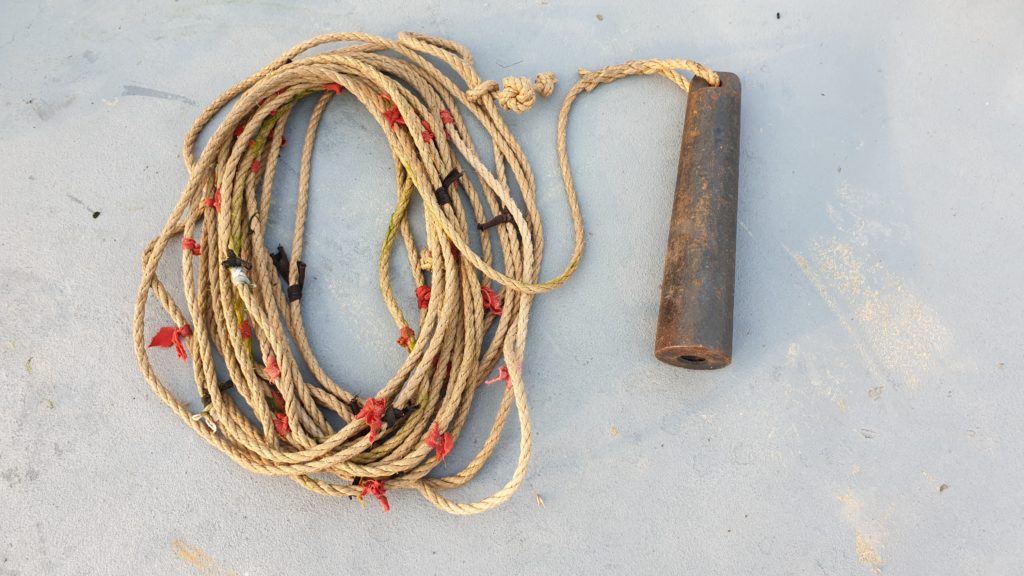
Depth sounding lead and rope

Never waste a moment to tell a good story. Usually, you’ll find informative or educational stories on this platform. This time, I literally found an opportunity to tell you a fun story. All it took, was this nifty little classic navigational instrument. The crew on the dredge used to calibrate their modern survey system1 or checked the delivered depth with this ancient tool. Ever seen one like this? It is a depth sounding lead2. Well, I doubt this one was made from lead, based on the estimated weight and appearance, but it does have all the other characteristics of a normal depth sounding lead.

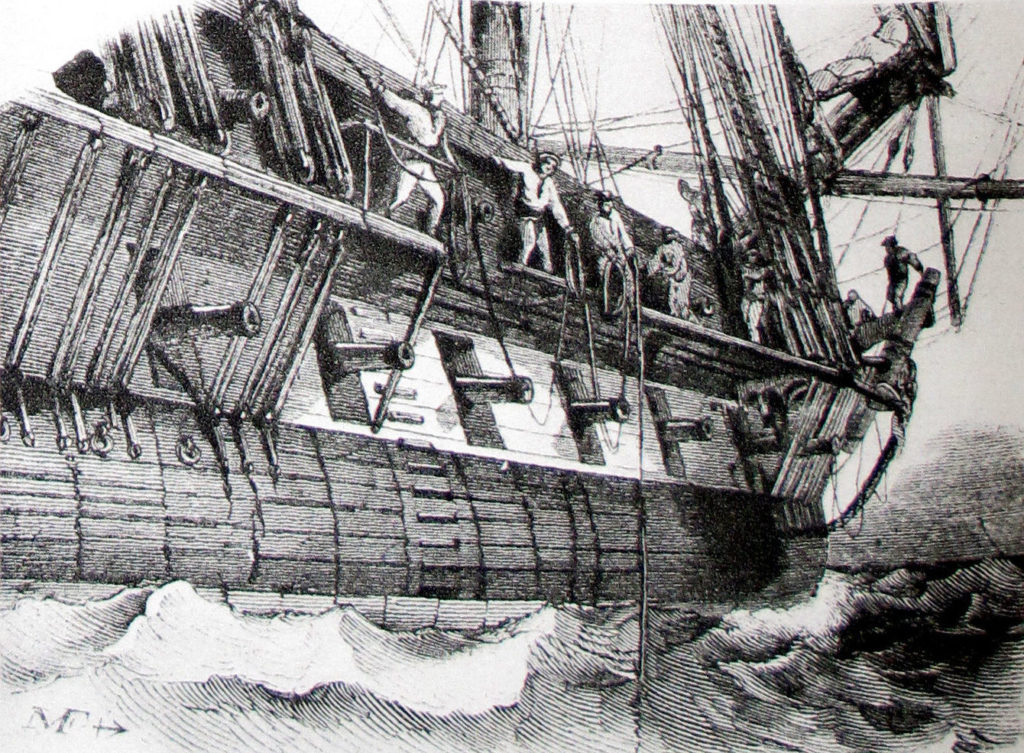
Evolving from a stone on a rope, the depth sounding lead was used to sound the depth. The plummet was made from lead. The rope was marked at regular intervals according to the shoe size of the current king. Cast overboard, the lead sank and keeping the rope tight, the depth at that location could be read from the markings on the vertical rope. It involved some nimble dexterity to stand at the lee side of a fast moving vessel in a choppy sea to handle the lead, a bundle of coiling rope and accurately reading the depth at the right moment. Hands down to all those seafarers that explored the world in old times and managed to navigate the globe on this instrument.

Sounding the depth manually with rope and lead (Credit: Wikipedia)

The depth was not the only information gained from this action. When you look closely, there is a hole at the bottom of the lead. On the picture above it is empty, but it ought to be filled with grease or wax. When the lead touched the bottom, some of the dirt was caught in the grease. When the lead was retrieved, the cling-ons were inspected. These could be either: sand, mud, gravel, peat, silt or even shells and other biological detritus. The material was reported on the charts also. This made navigation in charted waters easy: compare the sample with the indicated bottom condition. And that brings me to my fun story.

Before the Dutch reclaimed their land, there was a large water body in the Netherlands, called the ‘Zuiderzee’3. Or, South Sea as opposed to the North Sea, which most of you might know. This Zuiderzee, was extensively used for fishing. The skippers did not have charts, but they relied on oral tradition handed down through the ages of where what kind of soil would be available. Near Urk, you might find rocks. Near Pampus, there will be a lot of mud and around Stavoren, there is the famous ‘Vrouwenzand’ (Sand Bank of the Lady of Stavoren4). So, when the fishermen cast their depth sounding leads out, they knew the location of their vessel and the depth beneath it.

Map of the ‘Zuiderzee’ (Credit: Wikipedia)

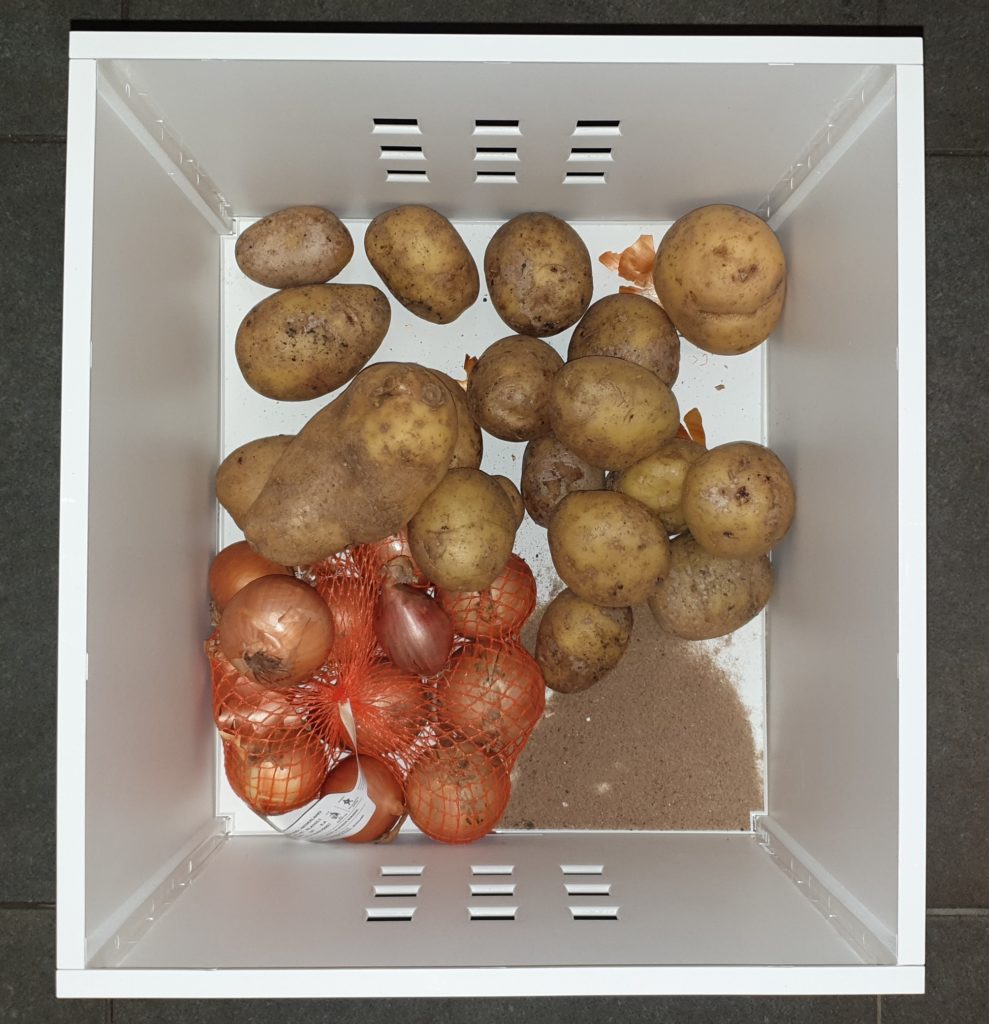
One of those skippers boasted he did not even have to see and feel the sample, but just by tasting it, he could pinpoint his location within a hundred yards. Hard to believe, right? The cabin boy on board thought likewise. So, he devised a cunning plan. After lunch, the skipper went down to the cabin for a short nap and instructed the cabin boy to bring him the lead to taste the sample. But, our clever cabin boy sank the lead in the crate with potato’s. The bottom of the crate was covered with clay from the potato’s. Carefully bringing the sample to the skipper, the cabin boy woke him up and awaited his reaction. The skipper woke up groggily and grappled for the lead with half closed eyes. He stuck his finger in the sample hole and tasted the material inside. Suddenly, his eyes went wide open and he exclaimed: Oh, disaster! The dikes have broken again! The land is flooded and we are sailing over farmer John’s potato patch!

You never know what you dredge from the bottom of a potato crate

References

  1. Positioning and survey system, Damen
  2. Depth sounding, Wikipedia
  3. Zuiderzee, Wikipedia
  4. Lady of Stavoren

See also