Increase Your Dredging Knowledge At The End Of The Discharge Line

Keeping watch at the end of the discharge pipe line

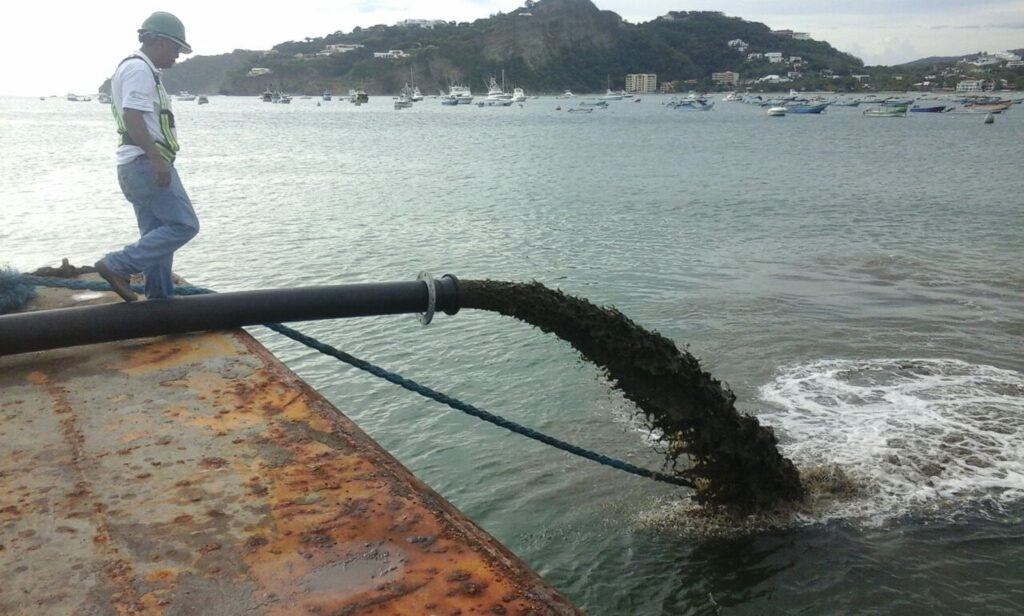
Solving something at the end of the pipe is usually a less desired approach. However, in dredging, it is the place where the valuable stuff is delivered, it might be a good place to start monitoring your process. Let me explain this to you by going back to latest discussed exhibit at the Damen Dredging Experience1.

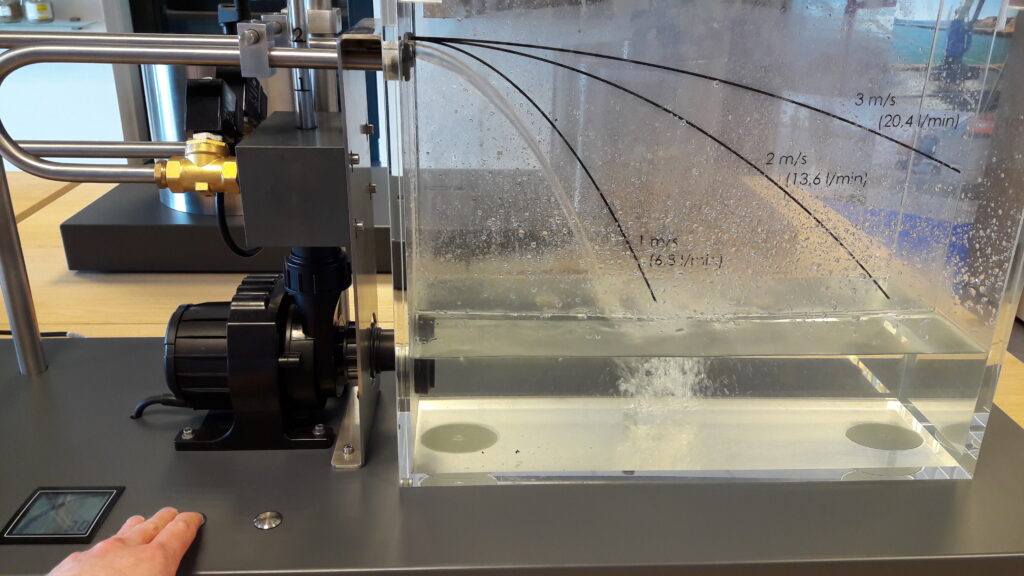
Pump power exhibit at the Damen Dredging Experience

You might have observed in the pictures of the pump power exhibit, that the velocity of the water flow is indicated by the parabolas of the trajectory. The arc of water is bound by gravity and obeys this trajectory always; independent of the density of the mixture. The two equations of motion can be combined, where the time parameter falls away and the height for a certain distance is only depending on the initial horizontal velocity2. As such, it is fairly accurate indication of the pipe flow. The calculation is universally applicable on earth and the results can be presented in a very simple graph to take with you. Every parabola is labelled with the corresponding horizontal velocity.

Nomogram to find end of pipe velocity

The above example is a straightforward method to measure the mixture velocity. The US Geological Survey even extended this approach as a standard method to measure the production of wells3. The resulting nomogram has a slightly different layout, as it is intended for finding the production instead of the velocity. For production planning, this will be useful. For monitoring your dredging process, the velocity might be more important. Both approaches of this elegant method do have the benefit, that there is no obstruction needed as in the case of an orifice measurement4.

Nomogram to find the end of pipe production

There is an unconfirmed anecdote that my old professor de Koning started his career as a velocity measurer. In the old days, when he was working as a twelve year old boy with the dredging company of his father. He was assigned to keep watch at the end of the pipe and monitor the mixture pouring out. He had a simple beam with a plumb bob. The beam was moved along the top of the pipe, until the plumb bob was touching the arc of mixture. On the beam were two markings. When the beam was moved in and passed the first mark, the mixture velocity was too low and a red warning flag had to be displayed. If the beam had to move out and the mixture velocity was too high at the second mark, a green flag had to be flown. There was also another white flag, in case only water came on the reclamation area. With this very simple setup, the dredge master could check through his binoculars what the state of the dredging process was.

Working principle and explanation of end of pipe meter

They were clever in those days. But the physics still apply. So, even today, one might have a situation, where there is no electronic velocity measurement available (broken, not supplied, not (yet) purchased) and you have to push the limits of the operating envelope of the dredging process. Then, there is probably always somebody around that might be appointed volunteer to be head of the velocity measurement crew. Who knows, he might have a bright future in the dredging academia.
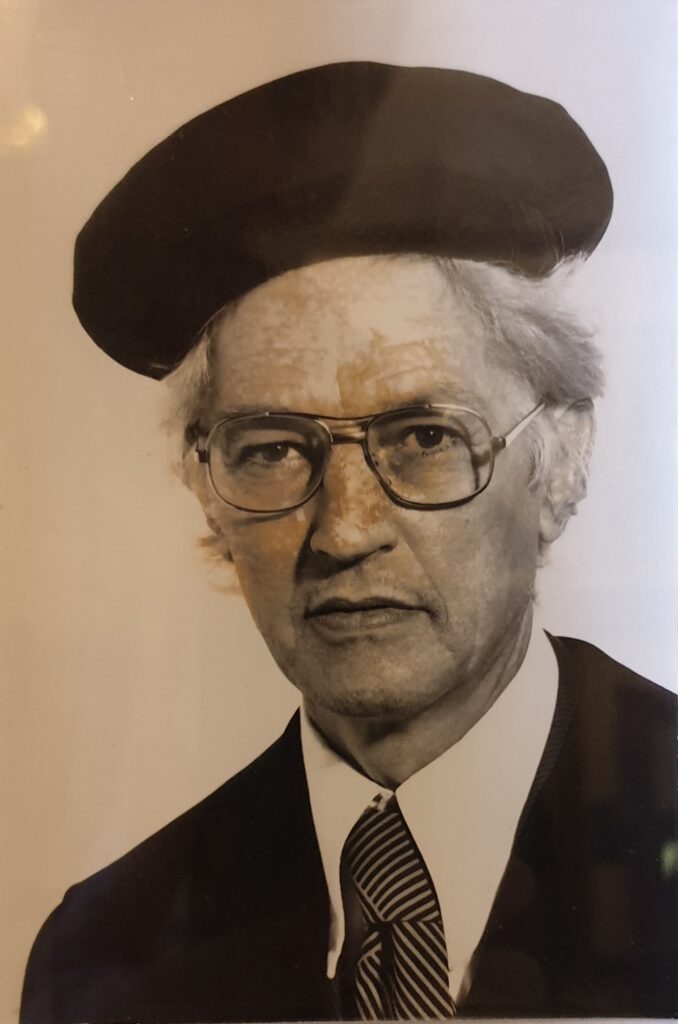
Professor de Koning of the dredging chair at the TU Delft (1981-1993)

References

  1. Presenting Pump Power Peculiarities, Playing With Pumps And Pipes, Discover Dredging
  2. Projectile motion, Wikipedia
  3. Estimating discharge from a pumped well by use of the trajectory free-fall or jet-flow method, US Geological Survey
  4. ISO 5167 Measurement of fluid flow by means of pressure differential devices inserted in circular cross-section conduits running full, ISO

See also

Presenting Pump Power Peculiarities, Playing With Pumps And Pipes

Pump power exhibit at the Damen Dredging Experience

Hej kära läsare, jag vill ta dig till ett land långt borta, för länge sedan. Min älskade Sverige.

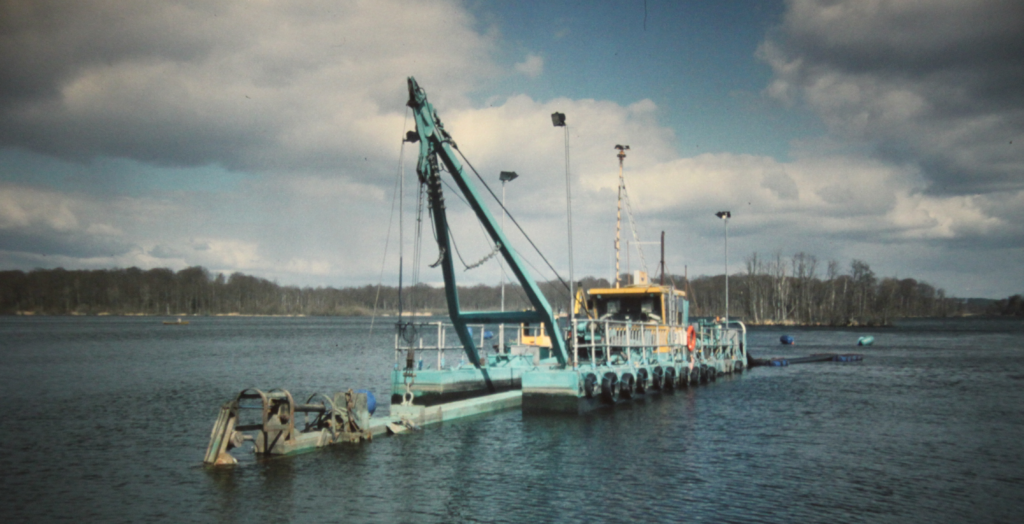
In 1996, I started my graduation with Skanska1 in Sweden. They had a project to clean up a lake2 with an auger dredge. The auger was not performing and they asked the Delft University of Technology to investigate the problem and write a report with my solution. Off, I went to Växjö and spent a year on a dredge. During my reconnaissance of the project in the first week, I noticed that the flow in the pipe line was very slow and the motor was hardly working at full speed. As an innocent student, I asked where they were pumping the material to. ‘Oh, through 7 kilometre of pipe and 30 meter up into the hills.’ They were lucky it was such a fluid material and did not settle at such a low velocity. I then proposed they should buy a booster station to increase production3, as I could not see anything wrong with the auger. ‘No, no. It has to be the auger and the engine is strong enough; you see, there is no power required.’

Clean up project at Södra Bergundasjön near Växjö

That was the first time I saw the slow flow fallacy at work. Intuitively you would expect, that a long pipeline would require more power to transport the mixture than a short pipe line. This is exactly what this exhibit is trying to visualise. Water can be pumped through either the short or long pipe. From the lines on the tank wall, you can read that the output velocity of the fluid is about 1.5 m/s. In the vertical pipe, the delivery pressure is indicated. Multiplying pipe velocity and fluid pressure results in the actual power in the pipe line. The pump has to provide this power, by converting electrical power to mechanical power and eventually fluid power. On the display at the left of the buttons, the consumed electrical power can be read.

Discharge capacity through the short pipe line

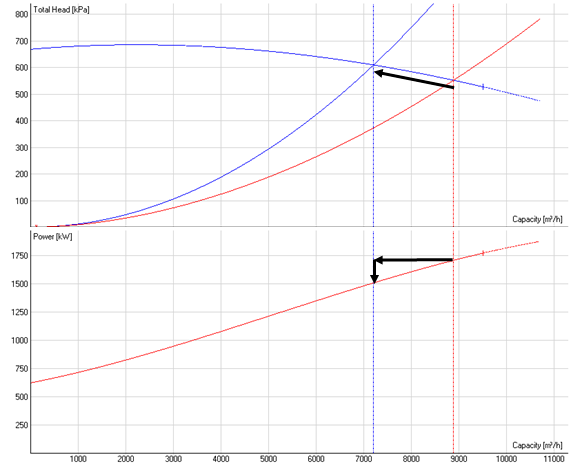
When you select the short pipe line, you have to notice the higher flow velocity and the required power at the display. Switching over to the longer pipeline, you will notice a drop in velocity. Due to the longer pipe, the fluid experiences more resistance. For the same pressure, the flow will be lower. Consequently, the power consumption will be lower also! This is exactly according to the theory. A pump at a lower capacity will consume less power, even if the pressure rises slightly.

Discharge capacity through the long pipe line

Off course, the delivered mixture will be less, on the longer line. You might increase the speed of the pump to have more pressure. And indeed, that would require more power. But there is a maximum speed on the pump drive. Same for a very short pipe. You might end up below the idle speed of the diesel engine. Be careful in your project layout that you do take into account this viable operating range for the length of the pipe line. A longer pipeline might require a booster station for increased production. Conversely, a shorter pipe line might be chosen with a smaller diameter for increased resistance and lower power consumption, while keeping the operating point of the dredge pump near the Best Efficiency Point.

Graphical explanation of the power consumption for identical pump speeds

And the Swedish dredge on 7 km of pipeline? It turned out, it was not a technical problem. They had no hurry. The contractor was hired per week on an open contract…

Auger dredge 'Detritus'
Auger dredge ‘Detritus’

References

  1. Welcome to Skanska, Skanska
  2. Södra Bergundasjön, Wikipedia (Swedish)
  3. Damen booster station, Damen

See also