Ewout van Duursen 25 Years: Monitoring the Hopper Process

Ewout van Duursen (l) and colleague installing monitoring software on TSHD Tommy Norton

Regularly, I do write about the adventures of a student internship or graduation that I am involved in. And it really helps those young aspiring engineers to be in the limelight of attention. Today there is a different story on my website, the 25 year work anniversary of my esteemed colleague Ewout van Duursen1. A fitting opportunity to celebrate his achievements during his long career at Damen Dredging Equipment. Ewoud’s specialties are drive systems and programming. And especially in applications for trailing suction hopper dredges. One of the products he has been working on tirelessly are hopper process monitoring systems2.
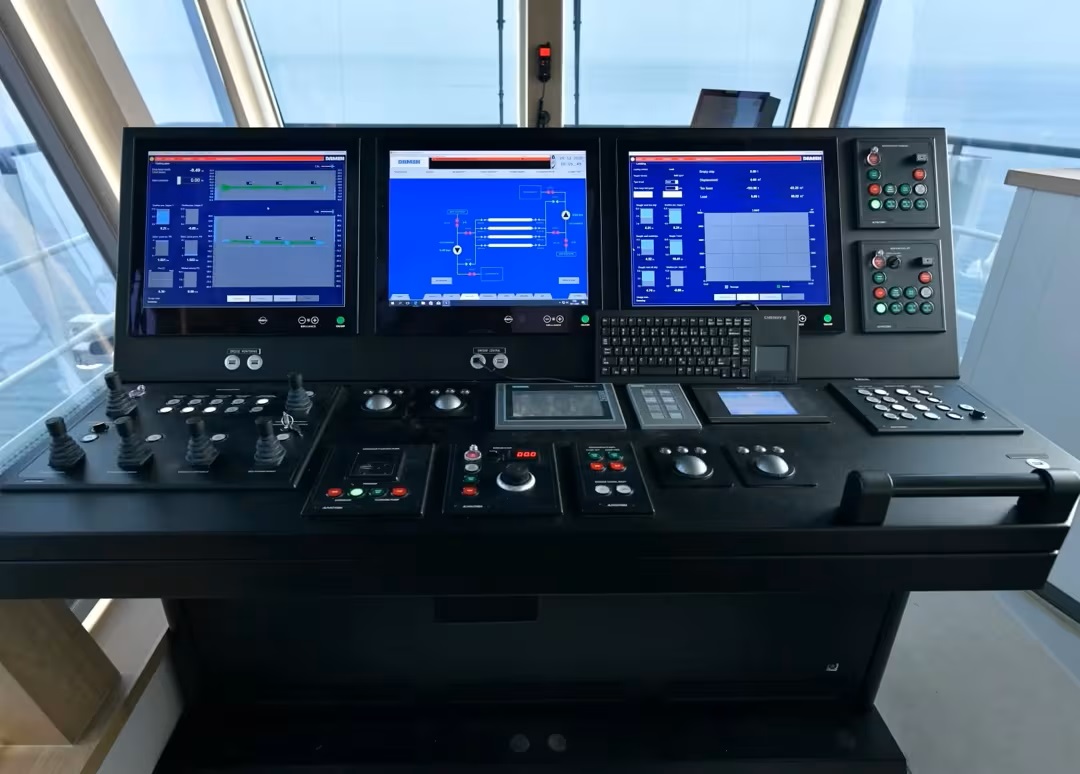
Dredge master console with hopper process monitoring installed

A good TSHD monitoring system will show a number of processes for operating a trailing suction hopper dredge.

  1. Trailing suction pipe visualisation
  2. Pump performance monitoring
  3. Hopper loading monitoring and draught measurement
  4. Survey and positioning
  5. Recording and reporting

One aspect I want to highlight is the hopper loading and draught measurement. There are some details that might be confusing at first.
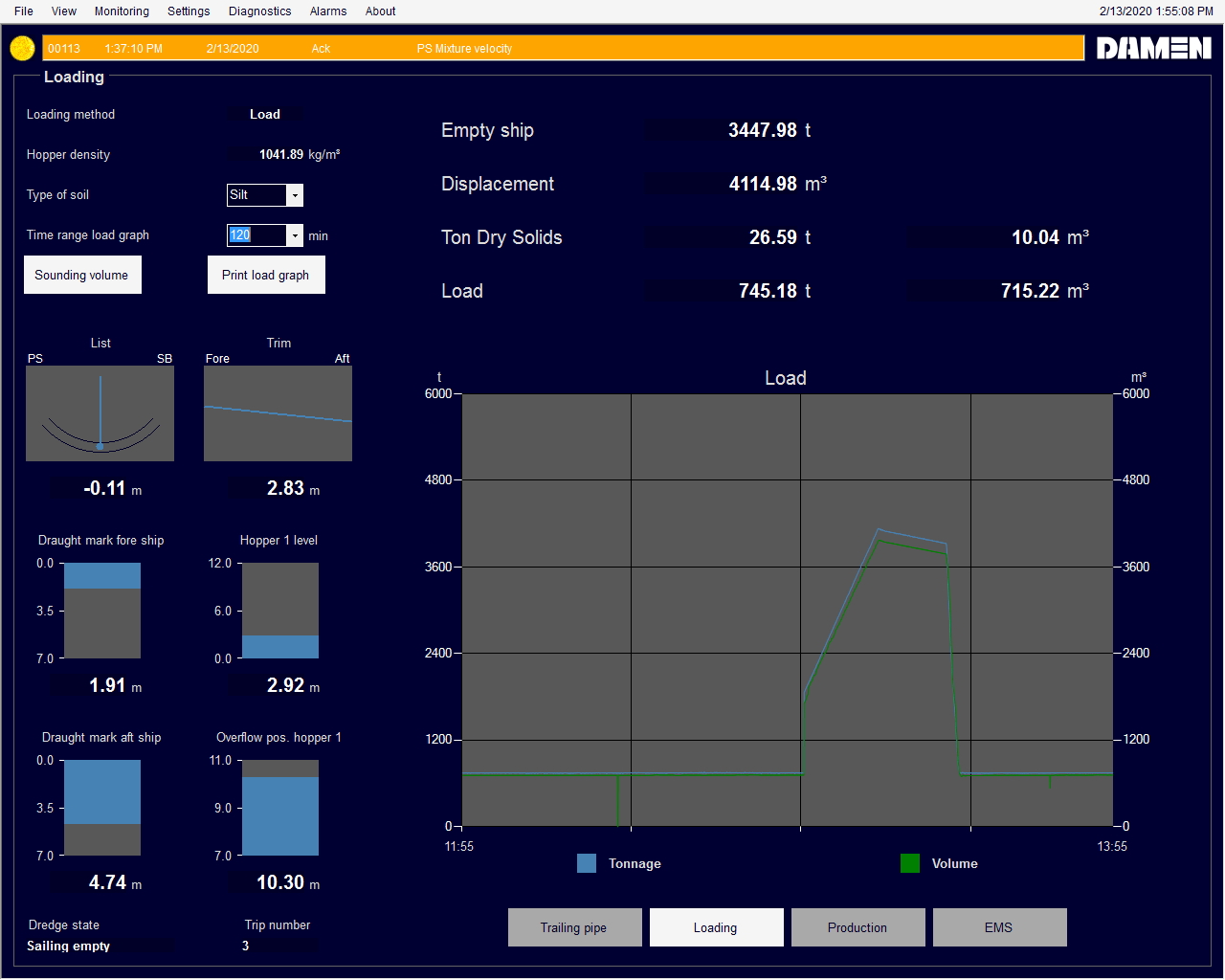
Screen shot of a sample hopper loading process

Take for instance a nominally 1000 cube hopper. It may be rectangular 32 m long, 9 m wide and 4 m deep, without any obstructions for simplicity. The mathematical capacity would be 1152 m³. But you don’t want to have the cargo spilling over the coaming. The maximum water level might be 0.5 m below the coaming making the volume 1008 m³. The maximum height of the telescopic overflow may be 0.7 m below the coaming level, as the water draws down about 0.2 m from stagnation level to the rim of the overflow. This measurable volume is now 950 m³.
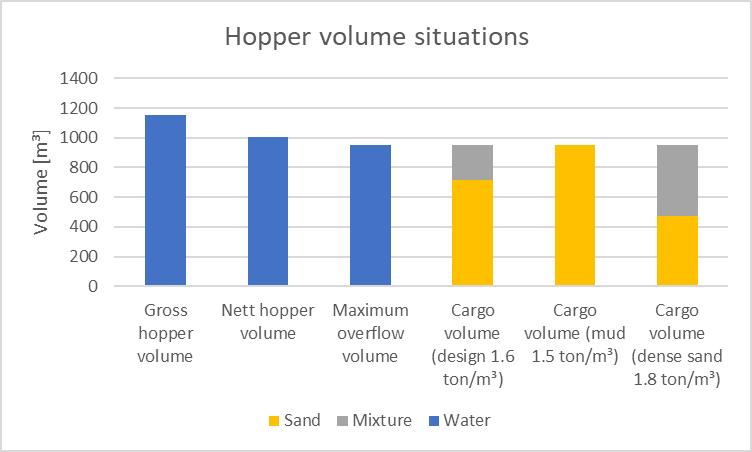
Diagram of various hopper loading volumes

And the cargo does not only have volume, it also has a mass. And as Archimedes already discovered, mass displaces its weight in volume of water. During design of the vessel and the hopper, the loaded sand is assumed to have a certain density, e.g. 1.6 ton/m³. But the density for the hopper may only be 1.5 ton/m³, as one has to accommodate for the transport water that also enters the hopper. So, you can’t fill the 950 m³ with 1521 ton of sand. The vessel can only carry 1426 ton of total cargo. This is 713 m³ sand of 1.6 ton/m³ and 237 m³ mixture of 1.2 ton/m³. It sounds disappointing when your 1000 cube hopper only carries 713 m³ of valuable sand. The 1.5 ton/m³ hopper density is rather low and the vessel is probably more intended for silt and mud with a lower in situ density. With mud of 1.5 ton/m³ density, you can load the hopper to the rim. And when you encounter heavier sand with e.g. a density of 1.8 ton/m³, don’t try to fill the hopper with this 713 m³ mentioned before. You’ll sink your ship. A good hopper loading monitoring system will enable you to monitor filling of the hopper to the maximum safe cargo capacity.

Heavy weather dredging (Retrieved from YouTube 18/10/2012, unknown source)

References

  1. DDE celebrates 25 year anniversary of Ewout van Duursen, Linkedin
  2. Monitor your dredging process: Optimise your TSHD dredge cycle times, Damen

See also

Dredging equipment and technology – Chap2: Trailing suction hopper dredger, CEDA

CEDA Dredging Days 2021: Sustainable Dredging And Innovation

Promotional banner of the CEDA Dredging Days 2021 (Credit: CEDA)

Tomorrow, another event with a long tradition will start: the CEDA Dredging Days1. Due to the Covid issues, this time, it will be a virtual event, just as a lot of other regular happenings. Hopefully, it will be the last days of this dreadful period. I can’t wait to meet people again in real life. Back at the office, we are slowly starting to get back. But meetings with people far outside the regular circle were difficult. For instance, I was a member of the Technical Paper & Program Committee and the preparation was completely digital.

Home page of your CEDA Dredging Days on the Swapcard platform (Credit: CEDA)

Now, the event itself is also digital. Of course, this is still not the real thing. Having a coffee and a chat in the lobby is a much more enjoyable experience than sitting in front of your screen. I have to say that with the Sawpcard platform2 selected by the organising committee, it is much easier to arrange your own program, adapted to your personal interests. Moreover, it will also facilitate meeting people with the same interest. In a sense, this might be an opportunity to approach those. In the real world, people will not get seated next to you when they have the same interest. And certainly don’t have them captioned on their chest.

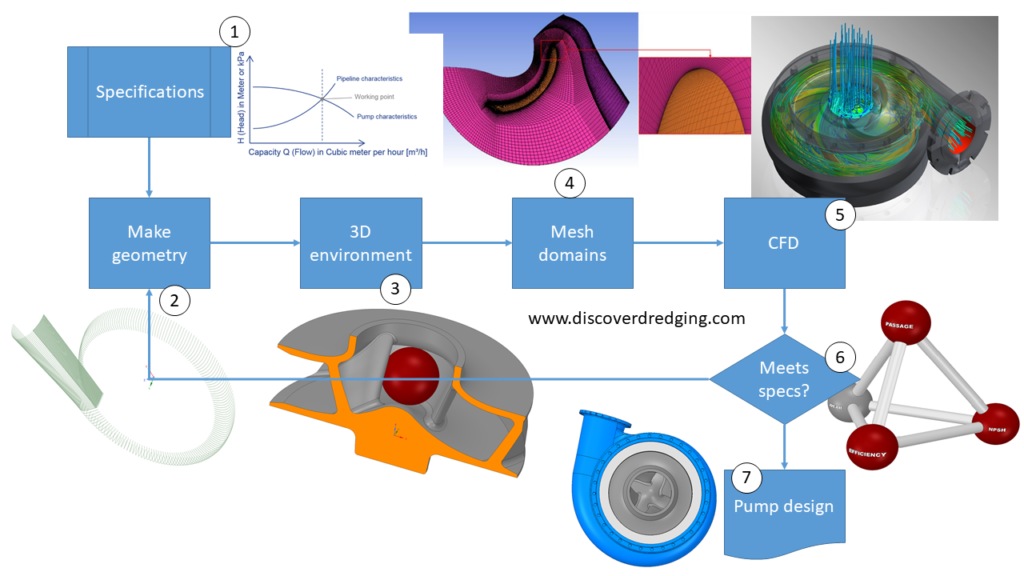
Pump design workflow (inspired by Suman Sapkota)

As member of the TPPC, I had the opportunity of a sneak preview of the articles and presentations and I can guarantee there are a lot of interesting sessions. For starters, there are three presentations by my colleagues. Suman Sapkota will have presentation on his research in various novel methods to apply numerical research into the design of dredge pumps3. We are happy to share with you some experiences and insights on the Dredging Days.

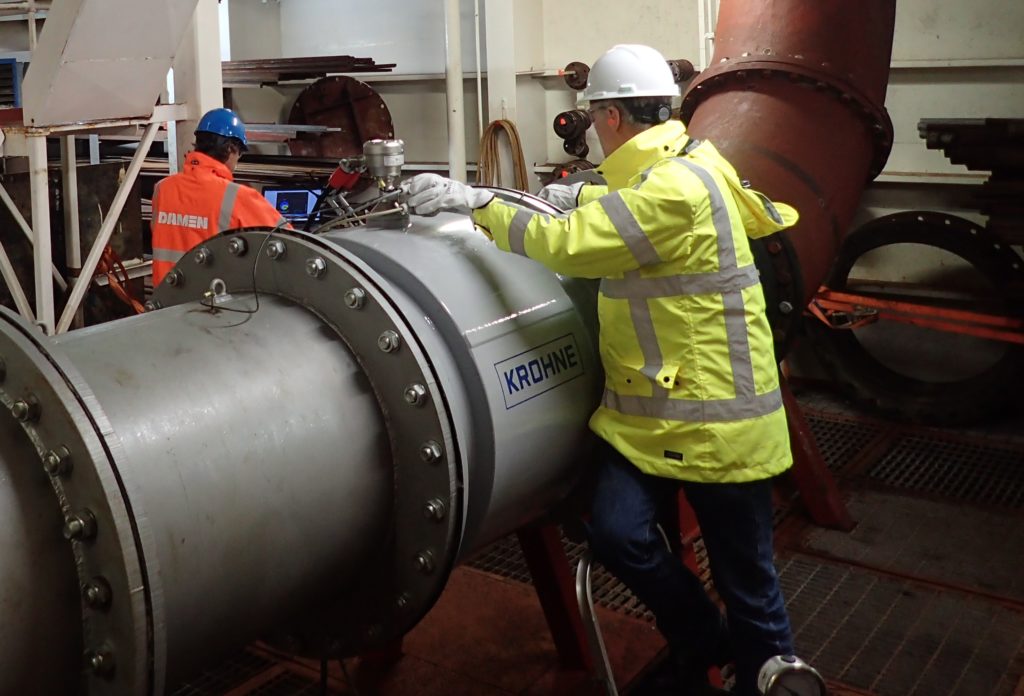
Testing the non-radioactive density sensor

Another presentation will be by Frank Bosman4. He has been active in the development of an instrument that will measure the mixture density, without using a radio-active source. This intelligent solution is not only more sustainable, but will also provide easier access to this information. If you don’t know the density, you are very likely to underperform with your dredge. He will present some experiences and data gathered on the performance of this system.

Example of recent electric DOP dredge family

Our last presentation will be by René Sens3. Less technical, but surely an interesting perspective on the future of dredging equipment. Everyone in the dredging community is aware of the necessity to change and adapt to a more sustainable approach of our dredging business. There is an urgency to reach the goals set by the UN to leave the world behind as a better place than we received it. Although usually an increase in size also increases the efficiency of a dredge, the UN goals look beyond that single parameter. With that in mind, small and medium size dredges will be far more interesting than at first sight.

Session 7: Young CEDA ask a CEO (Credit: CEDA)

There will be a lot more going on and I could produce a long list of other interesting presentations. I think you should also check out: Edwin de Hoog and Joep Goeree, Basel Yousef and Jeroen van Stappen, and if you really want to get academic: Janek Gundlach, Ebi Shahmirzadi and Arno Talmon. You can just add to your own list and see who also joins in in the audience. Other interesting sessions will be the student ‘Flash Talks’5 and the ‘Young CEDA ask a CEO’ session6 with Peter Berdovski and Kees van de Graaf. And I am very curious what the other working groups and commissions of CEDA have to present about their work.

Thursday evening is the big get together of the dredging community; meet you there! (Credit: CEDA)
Dredging Days as a they used to be: personal interaction (Credit: CEDA)

References

  1. CEDA Dredging Days 2021, CEDA
  2. CEDA Dredging Days 2021, Outsourced Events
  3. Session 5: Latest in dredging equipment and technology
  4. Session 2: Developments in modelling and measuring hydraulic transport, CEDA
  5. Session 8: Young CEDA Flash Talks
  6. Session 7: Young CEDA ask a CEO

See also

Student Interviews On Their Projects With Our Dredge Pump Slurry Test Circuit In Damen Nieuws

Damen dredge pump slurry test circuit on the outfitting quay in Nijkerk

‘What sets men apart from boys is the size of their toys.’ And that wisdom applies to a lot of students that we’ve had at our company and have grown from boy to man working on our dredge pump slurry test circuit for their internship or graduation. As the test circuit has seen some intense activity these last months and yielded us with some very innovative concepts and possible new products, it was the right time to cover this interesting piece of equipment in the internal Damen Nieuws1 of January 2021 to share with all our colleagues. And that occasion in turn is an excellent opportunity to share with you the article and zoom into some of the details of the circuit.

General arrangement of the dredge pump slurry test circuit

Already more than ten years ago, we felt the need to have our own testing facility to experiment with the processes in our dredges or check the performance of new products2. After defining the specifications of the circuit, we had Hylke Visscher assisting us in designing the circuit for his internship. Subsequently he could actually supervise the manufacturing of the circuit for his graduation. Hylke worked in close cooperation with Arjan de Vries who in turn did his graduation on the building, outfitting and commissioning of the circuit. Both students from then are now esteemed and valuable colleagues as we have appreciated their performance on their projects.

After those ten years, we have a new generation of students working on the circuit. Arend van Roon recently graduated on his project with the circuit, as covered in my last post3. Currently Wim Kleermaker is preparing his experiments on the dredge pump. Upcoming is Williem Salim, not yet mentioned in the article, but now already starting his internship on the instrumentation of our laboratory. All project on the test circuit are supervised by Pieter van der Kooi as plant manager, Frank Bosman as student coordinator. Depending on the project, Ewout van Duursen, Suman Sapkota and me are supervising the student projects more on a subject level.

Various executions of a U-bend c-meter in the test circuit, for delivery and installed on a dredge

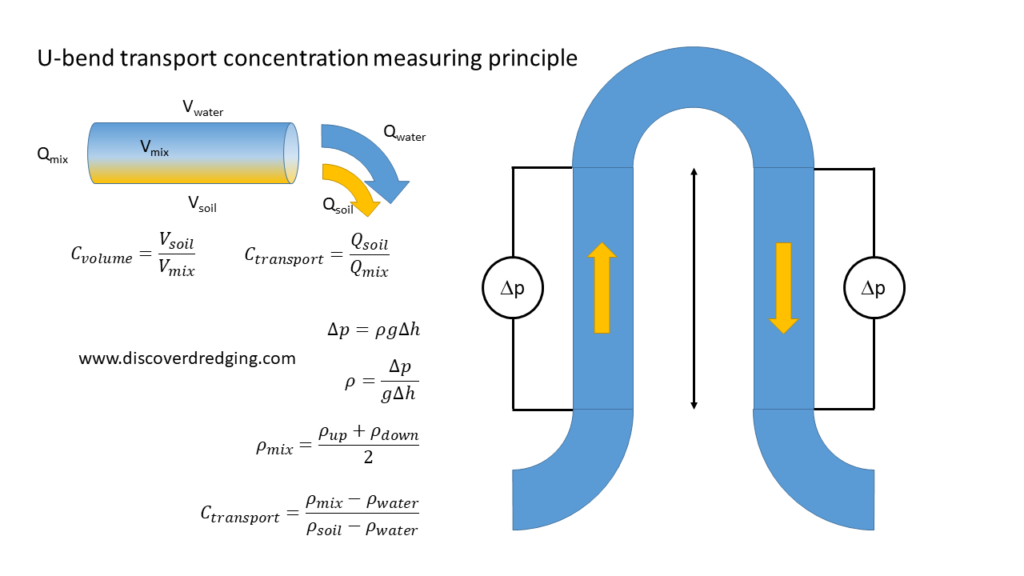
The odd thing you might notice in the loop of the test circuit is the U-bend directly after the dredge pump. Contrary to most first impressions, it is not to generate resistance, although it does so slightly. It is to measure how much sand has been transported. As the circuit is by nature closed, there is no way to check how much we’ve transported through the dredge pump. Sure, there is a density sensor4, but this will only indicate the so called volumetric density; how much material is there in the cross section. It will not differentiate between fast moving slurry and a slow sliding bed. In the extreme you could have a static bed, indicating a very high concentration. Multiplying this with a very high fluid speed, that is squeezed through the remaining aperture, you would expect an impressive production. Wrong! Not a single particle gets transported.

Enter: the U-bend. It measures the hydrostatic pressure differences over a certain hight in the upstream and downstream branches. This will cancel out the velocity differences but will yield the actual transported mass flow. So, that is how we can claim that we already dredged millions of cubic meters, all on the floor area of a 40 foot container flatbed.

Explanation of the U-bend measuring principle

References

  1. Testcircuit, Damen
  2. Innovation, Damen
  3. Graduation of Arend van Roon: Detecting Flow Regime And Optimising Transport Efficiency, Discover Dredging
  4. Production management, Damen

See also