Ewout van Duursen 25 Years: Monitoring the Hopper Process

Ewout van Duursen (l) and colleague installing monitoring software on TSHD Tommy Norton

Regularly, I do write about the adventures of a student internship or graduation that I am involved in. And it really helps those young aspiring engineers to be in the limelight of attention. Today there is a different story on my website, the 25 year work anniversary of my esteemed colleague Ewout van Duursen1. A fitting opportunity to celebrate his achievements during his long career at Damen Dredging Equipment. Ewoud’s specialties are drive systems and programming. And especially in applications for trailing suction hopper dredges. One of the products he has been working on tirelessly are hopper process monitoring systems2.
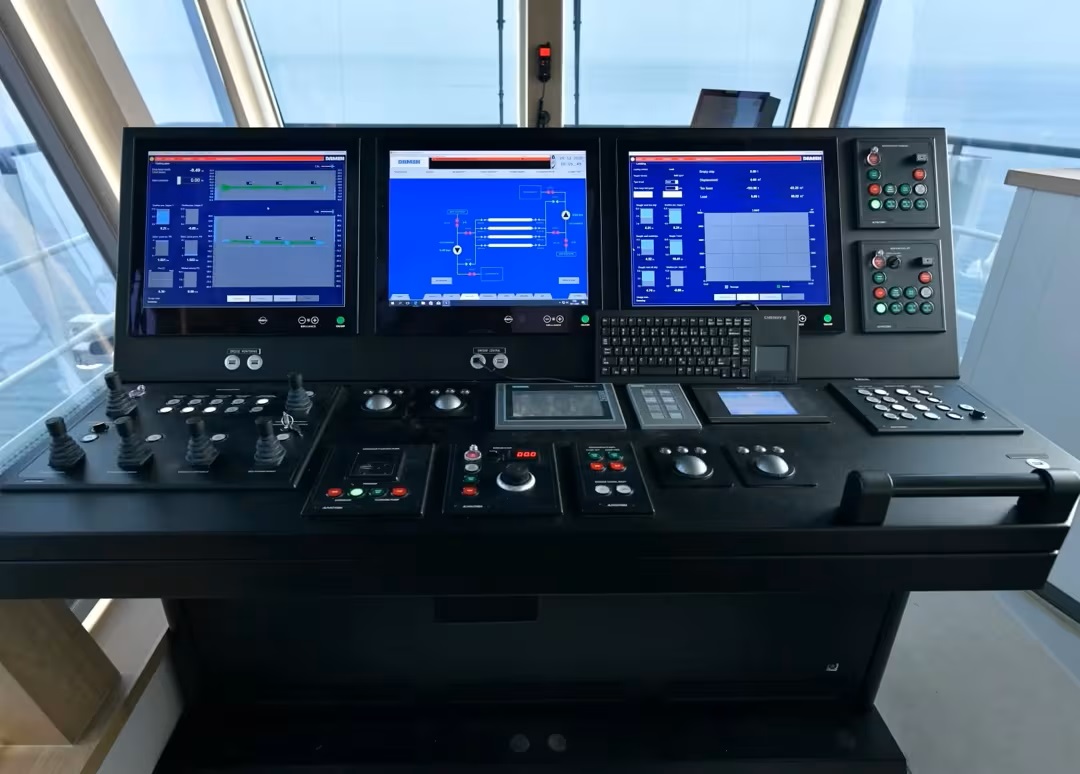
Dredge master console with hopper process monitoring installed

A good TSHD monitoring system will show a number of processes for operating a trailing suction hopper dredge.

  1. Trailing suction pipe visualisation
  2. Pump performance monitoring
  3. Hopper loading monitoring and draught measurement
  4. Survey and positioning
  5. Recording and reporting

One aspect I want to highlight is the hopper loading and draught measurement. There are some details that might be confusing at first.
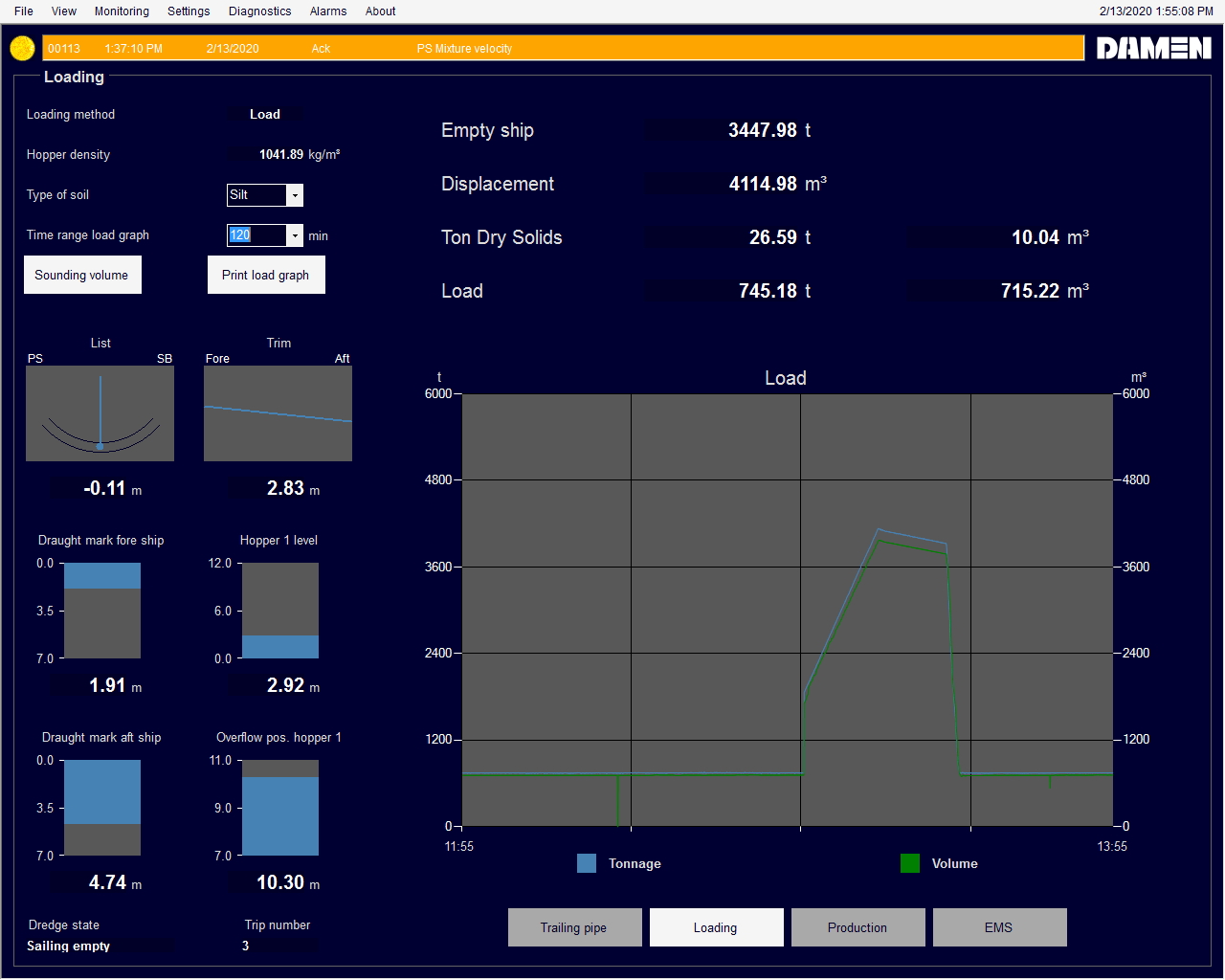
Screen shot of a sample hopper loading process

Take for instance a nominally 1000 cube hopper. It may be rectangular 32 m long, 9 m wide and 4 m deep, without any obstructions for simplicity. The mathematical capacity would be 1152 m³. But you don’t want to have the cargo spilling over the coaming. The maximum water level might be 0.5 m below the coaming making the volume 1008 m³. The maximum height of the telescopic overflow may be 0.7 m below the coaming level, as the water draws down about 0.2 m from stagnation level to the rim of the overflow. This measurable volume is now 950 m³.
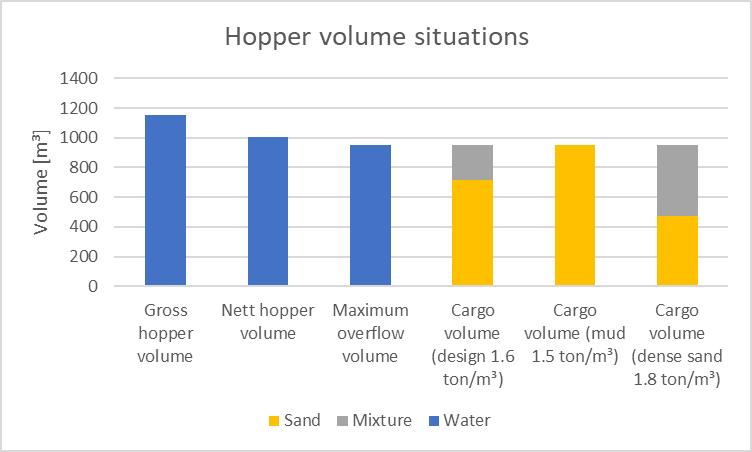
Diagram of various hopper loading volumes

And the cargo does not only have volume, it also has a mass. And as Archimedes already discovered, mass displaces its weight in volume of water. During design of the vessel and the hopper, the loaded sand is assumed to have a certain density, e.g. 1.6 ton/m³. But the density for the hopper may only be 1.5 ton/m³, as one has to accommodate for the transport water that also enters the hopper. So, you can’t fill the 950 m³ with 1521 ton of sand. The vessel can only carry 1426 ton of total cargo. This is 713 m³ sand of 1.6 ton/m³ and 237 m³ mixture of 1.2 ton/m³. It sounds disappointing when your 1000 cube hopper only carries 713 m³ of valuable sand. The 1.5 ton/m³ hopper density is rather low and the vessel is probably more intended for silt and mud with a lower in situ density. With mud of 1.5 ton/m³ density, you can load the hopper to the rim. And when you encounter heavier sand with e.g. a density of 1.8 ton/m³, don’t try to fill the hopper with this 713 m³ mentioned before. You’ll sink your ship. A good hopper loading monitoring system will enable you to monitor filling of the hopper to the maximum safe cargo capacity.

Heavy weather dredging (Retrieved from YouTube 18/10/2012, unknown source)

References

  1. DDE celebrates 25 year anniversary of Ewout van Duursen, Linkedin
  2. Monitor your dredging process: Optimise your TSHD dredge cycle times, Damen

See also

Dredging equipment and technology – Chap2: Trailing suction hopper dredger, CEDA
Another Fascinating Exhibit To Help You See Through The Dust


New settling and sedimentation exhibit at the Damen Dredging Experience

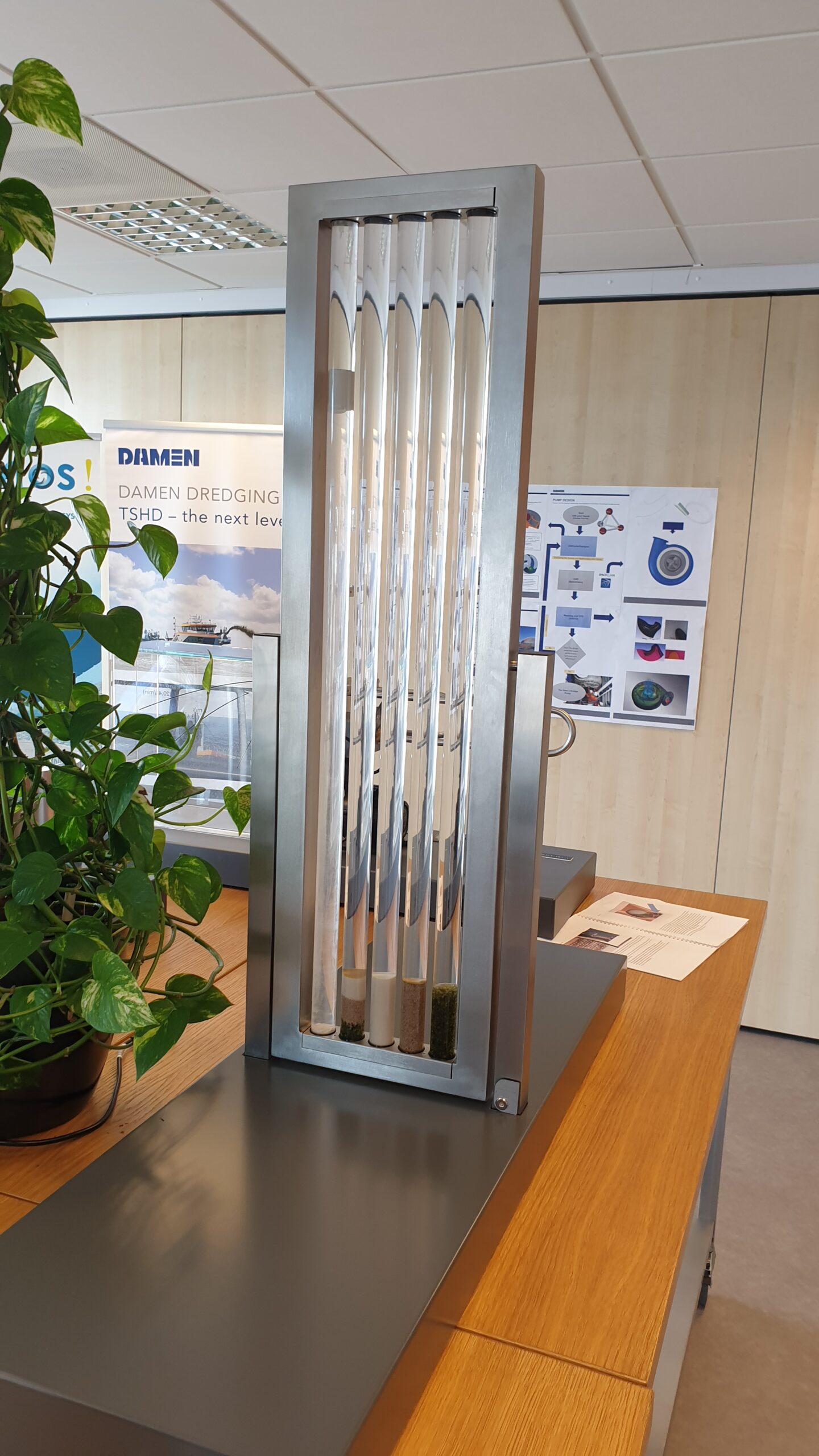
Sometimes, explaining a part of the dredging process can be as simple as seeing through the mixture. In this exhibit we can demonstrate what happens beneath the surface of the cargo in the hopper1,2,3. Along the way, we explain some quirky behaviour in other phases of the dredging process, also. The exhibit consists of five tubes in a frame, that can rotate around a horizontal axis. In the tubes are various types of soils. Each with their own settling behaviour. The exhibit was recently added to the Damen Dredging Experience. One more reason to highlight it here.

Samples in the settling and sedimentation exhibit

One major part in the dredging process is the hydraulic transport of particles in a carrier fluid. Pickup and transport have been touched upon in previous posts4,5. Here we concentrate on the end of the process: settling and deposition. This can be either in a hopper or on the discharge area. In both cases you will only see the fluid surface during the process and at best the top of the deposited sediment. How the material came there, was deposited and stacked up can’t be readily seen. As the tubes allow these processes to be observed from the side, we can follow the events.

Multi fraction sediment after settling

The exhibit can be started by upending the frame with the tubes. The material that sat in the lower end gets now on the top end. They all are released at the same time and we see immediately see the differences in settling velocity for the different particle sizes6. The gravel falls down within ten seconds. The sand is slower and the clay even has problems getting started. One nice observation is the mixture of soils. Against the height of the tube, the fractions in the sample are released simultaneously. Still, the fractions separate over the fall height and stack up again in their original order. This not only happens in the tube. In the hopper or the discharge area, a widely graded sediment will sort itself to the various fractions.

Table of irregular shapes (Source: Wikipedia)

Although for all the samples the particles are released simultaneously, you can still see a slight difference in settling velocity within each sample. This can be either due to slight variations in size that are possible within each mesh size used for sieving. Another cause for the differences might be the differences in shape. A perfectly spherical particle will have a faster settling velocity than an oddly shaped potato7.

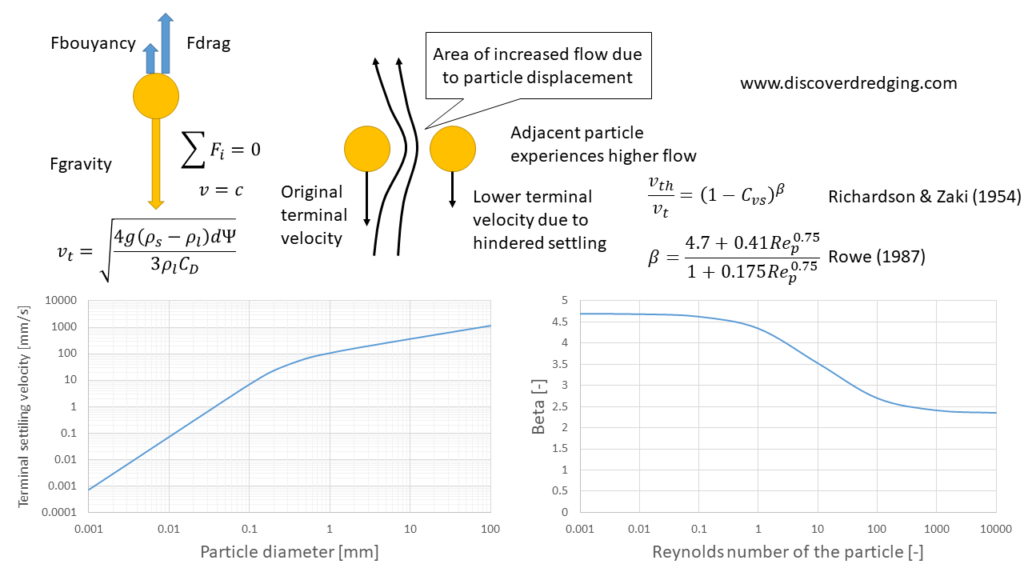
Explanation of terminal velocity and hindered settling

And even then, the initial particles that fall down have a greater velocity than the particles in the bulk of the sample, even when having the same particle size and shape. This is due to the water flowing up around the particle. The upward flow is slowing down an adjacent particle. This interaction is called ‘hindered settling’. At high concentrations this can contribute to the efficiency of pipe line transport8. But for the settling it is really hindering the loading time.
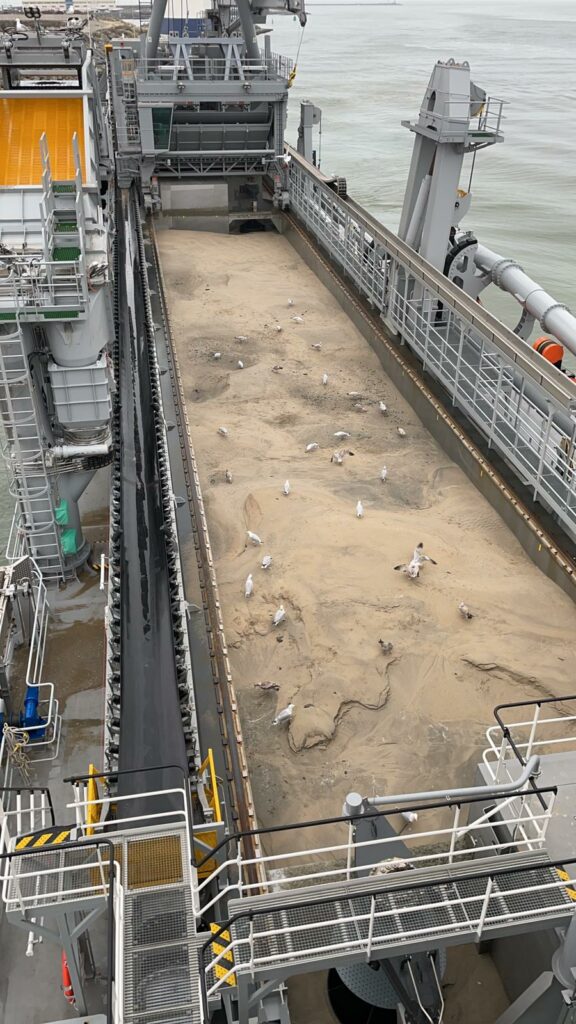
At the very end of the settling, the particle gets deposited at the bottom, or on top of another. The water that is caught in between has to escape. This causes one last puff of fluid to flow upward and take the very find dust present upward. This happens with each particle that settles and causes the layer of dust to lift to the surface of the deposited sediment. So even when loading a cargo of gravel, you will always end up with a layer of dust on top. So, don’t judge the quality of the cargo just by the dust you see on top. Take a deeper sample or base your evaluation on the signals from the sensors from the screening tower.

Full cargo load of gravel, covered with dust. And the seagulls know that the dust layer also collects all the snacks

References

  1. Hopper Loading: What Happens Beneath the Surface, Discover Dredging
  2. Graduation of Ben Sloof: Hopper Loading Model and Overflow Losses, Discover Dredging
  3. IADC Young Author Award for 1DH Hopper Loading Model of Jordy Boone, Discover Dredging
  4. Loose Sand, How Hard Can it Be? Discover Dredging
  5. Graduation of Arend van Roon: Detecting Flow Regime And Optimising Transport Efficiency, Discover Dredging
  6. Terminal velocity, Wikipedia
  7. Sphericity, Wikipedia
  8. Slurry Transport Fundamentals, Limit Deposit Velocity Framework – 2nd Edition, SA Miedema

See also

Ben Sloof Nominated For KIvI Best Offshore Graduate Student

3D simulation of a hopper loading process

Ben Sloof was one of the best graduate students we had here at our company. For his thesis1, he tackled a complex problem and managed to model this in a reliable simulation. Now he is nominated for best Offshore Graduate Student. Today, there will be a KIvI Offshore lecture evening with a ceremony to award the prize2. Once again3, Ben will deliver a capturing pitch on his thesis. So, let’s review what he has achieved.

Van Rhee and similar ‘Euler’ models

At the chair of Dredging Technology of professor van Rhee, a lot of effort is put in describing the hopper loading in so called ‘Euler’ models. This is where you calculate the flow of the fluid and derive the flux of material that is carried within. Ben is standing on the shoulders of giants here, as by now there are a lot of models available4. We opted to use an existing simulation platform: OpenFOAM. One of the plugins for this open source program is DriftFlux, where the valuable grains are treated as a continuum fluid moving through the rest of the fluid. The extra effort of Ben, was to modify this DriftFlux plugin to account for settling and scour. This is in itself is already an unprecedented feat. Complicated by the unstructured calculations within DriftFlux and OpenFOAM. Nonetheless, after careful verification, he was able to perform interesting simulations of the hopper loading process.

Concentration and Velocity

After careful examination of the simulations, Ben started to see patterns in the flow. These set him on a track to build a whole new model. This new layer model credibly describes the process as well, without the complexity of a CFD simulation. As the development of a multi-fraction version of the OpenFOAM platform is still in progress, final verification is still pending. At least, the differences we see between the single fraction model and reality can be explained by what can be expected. It is open to further expansion with future research and can be used as a starting point for the next improvement.

Introduction to the key components of the proposed new ‘Layer Model’ (1DV)

And that is an insight worthy of extra appraisal: finally cracking the riddle of the sands settling in the hopper. We hope you will receive the prize. You deserve it.

Good luck Ben, we wish you all the best on your future voyages to unknown destinations. We are sure you’ll be blessed and a blessing, wherever you go.

Setting sail to distant shores

References

  1. Graduation of Ben Sloof: Hopper Loading Model and Overflow Losses
  2. KIvI Evening: Johan Sverdrup Platform Installatie
  3. Hopper Loading: What Happens Beneath the Surface
  4. IADC Young Author Award for 1DH Hopper Loading Model of Jordy Boone

See also